I kept a note on my phone for a year: every nail appointment, what I paid, and how many days it lasted before I was picking at it.
The total was uncomfortable. Not because salon manicures are overpriced – they aren’t, for what they are – but because I’d never once looked at the number as an annual figure. I’d only ever seen it fifty dollars at a time.
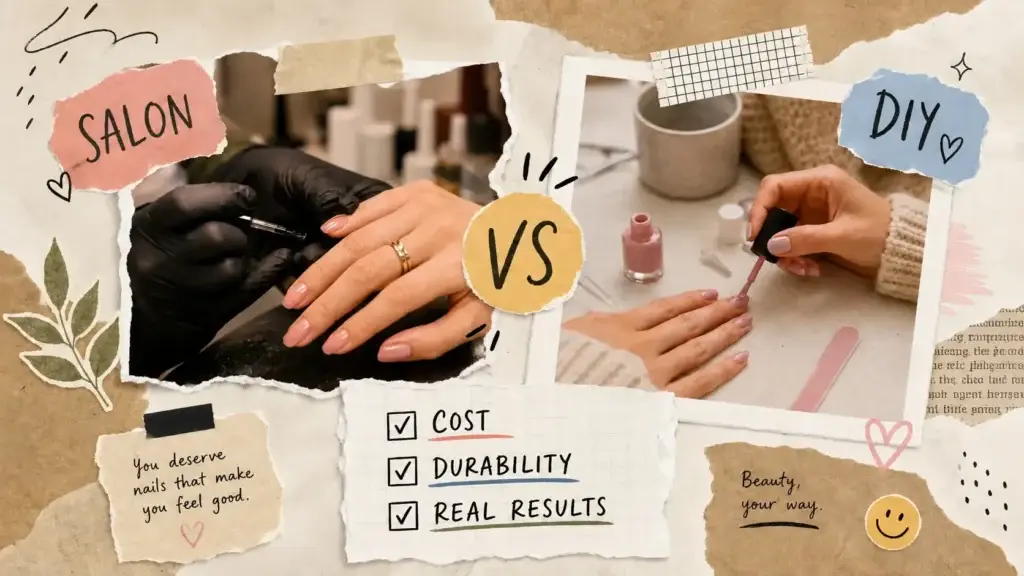
That’s the whole problem with this comparison. Salon versus DIY gets argued as a taste question when it’s mostly an arithmetic question, and the arithmetic changes completely depending on how often you get your nails done and which finish you want.
Quick Answer: Which Is Better, Salon or DIY?
It depends almost entirely on frequency.
- If you get gel nails every two to three weeks, DIY wins decisively on cost. A home kit typically pays for itself within one to three sets, and the annual gap runs into four figures.
- If you get your nails done a few times a year, the salon wins. There’s no meaningful saving to unlock, and you skip the learning curve entirely.
- If you want acrylics, extensions or intricate art, the salon wins regardless of frequency. Those require training and equipment that a home kit doesn’t replace.
The durability gap between a well-executed home gel and a salon gel is real but smaller than most people expect – roughly three to seven days. The gap between a carelessly executed home gel and a salon gel is enormous. That difference is entirely down to prep.
What Each Option Actually Costs
Most cost comparisons fail because they mix up startup cost with running cost. Separating the two is what makes the picture clear.
Salon pricing, honestly
Prices vary more by geography than by anything else, so treat the following as ranges rather than a single national figure. Across US markets in 2026:
| Service | Typical range | Notes |
|---|---|---|
| Regular polish manicure | $20–$35 | Cheapest, shortest wear |
| Gel manicure | $35–$60 | The most common recurring service |
| Gel mani-pedi combo | $70–$110 | |
| Acrylic full set | $45–$65 | $60–$80 with art |
| Acrylic fill | $30–$50 | Every 2–3 weeks |
| Builder gel / BIAB overlay | $65–$85+ | Growing fast on salon menus |
Location matters more than anything. Industry pricing data has tracked gel manicure averages ranging from the high teens in the least expensive states to the mid-fifties in the most expensive – a gap driven almost entirely by rent, wages and salon density rather than skill. Manhattan and other dense metros sit at the top of every range; the South and Midwest sit at the bottom.
Then add the tip. A customary 15–20% turns a $45 gel manicure into roughly $52–$54 out the door. That’s the number to use in any comparison, not the menu price.
DIY: startup vs. running cost
| Upfront | Per manicure after that | |
|---|---|---|
| Gel kit (lamp, base, colour, top, tools) | $50–$150 | $2–$8 in product |
| Regular polish | $8–$15 per bottle | ~$0.40–$1.50 per use |
| Press-ons | — | $5–$35 per set |
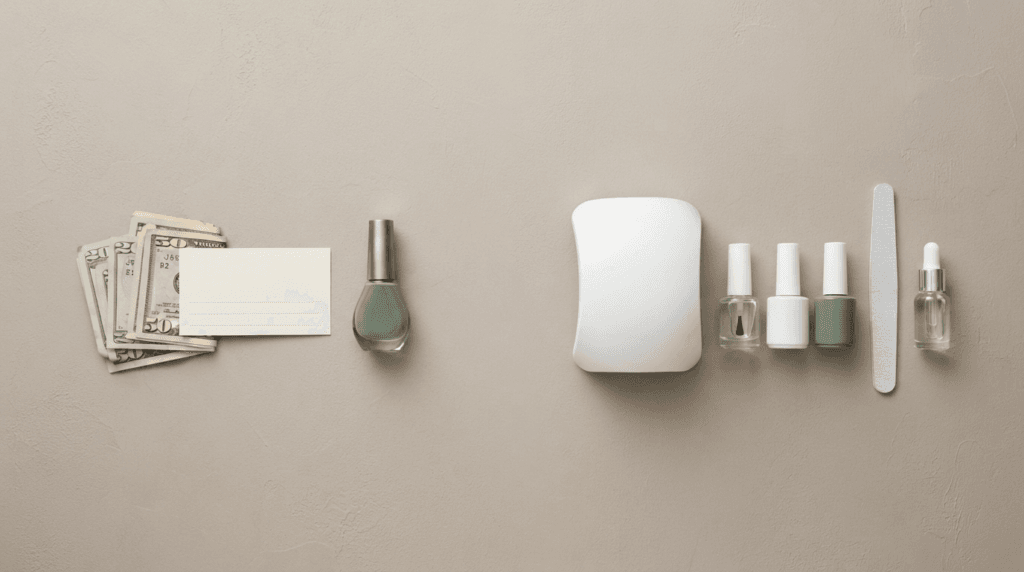
The $50–$150 upfront number is what stops most people, and it’s also the number that stops mattering after about the third set. Once the lamp is on your shelf, you’re comparing $50-plus per salon visit against a few dollars of product.
The Cost-Per-Day Number Almost Nobody Calculates
Sticker price is the wrong unit. What matters is what you pay per day of actually having nails you like.
| Option | Typical cost | Typical wear | Cost per day |
|---|---|---|---|
| Salon gel (with tip) | ~$53 | 14–21 days | $2.50–$3.80 |
| Salon regular polish (with tip) | ~$30 | 5–7 days | $4.30–$6.00 |
| At-home gel (after kit) | $2–$8 | 14–18 days | $0.15–$0.55 |
| At-home regular polish | ~$1 | 5–7 days | $0.15–$0.20 |
Two things jump out of that table.
First, salon regular polish is the worst value on the list. You’re paying a per-day rate higher than gel for a manicure that chips within a week. If you’re going to the salon at all, gel is usually the more economical choice – the opposite of what the menu price suggests.
Second, the home gel gap is an order of magnitude, not a percentage.
What that looks like annually
For someone on a biweekly schedule – 26 visits a year:
- Salon gel: roughly $1,100–$1,800 per year including tips, depending on your city.
- At-home gel: roughly $100–$350 in year one (kit plus product), and $50–$210 every year after.
That’s a first-year saving somewhere around $1,000–$1,500, and more in high-cost metros. For someone going once a month, the saving roughly halves but is still substantial. For someone going three times a year, it barely exists – which is exactly why frequency is the deciding variable.
How Long Each Option Actually Lasts
Durability isn’t only a product question. It’s a prep question and a lifestyle question.
Wear time by service
| Service | Realistic wear | What ends it |
|---|---|---|
| Salon gel | 14–21 days | Regrowth becomes visible before the gel fails |
| Well-prepped home gel | 14–18 days | Same — regrowth, not chipping |
| Poorly prepped home gel | 3–7 days | Lifting at the edges |
| Acrylics | 2–4 weeks | Needs a fill, not removal |
| Regular polish (anywhere) | 5–7 days | Chipping |
| Press-ons | 1–2 weeks | Lifting, usually from skipped prep |
Notice that salon gel and well-prepped home gel land within a few days of each other. The dramatic gap in the table isn’t between salon and home. It’s between good prep and no prep.
Why home results vary so much more
A nail technician runs the same sequence on every client, every time. At home, four steps get quietly dropped:
- Dehydration – leaving natural oils on the nail plate, which actively prevents bonding.
- Primer – which matters most on naturally oily nail beds.
- Thin layers – one thick coat instead of two thin ones.
- Full cure times – cutting the lamp short.
Those four shortcuts account for the overwhelming majority of “my home gel peeled in three days” complaints. None of them is a skill. All of them are discipline.
Match the service to how you live
If your hands are in water constantly, gel will underperform no matter who applies it. Healthcare workers, chefs, bartenders, swimmers and new parents all tend to see early lifting from any gel product because of moisture exposure – regular polish or press-ons are more practical, because replacing them frequently is the point rather than the failure.
If you’re not soaking your hands all day and low maintenance is the goal, gel earns its price through longevity alone.
Nail Health: The Risks on Both Sides
Neither route is risk-free, and the risks are genuinely different.
The main DIY risk is allergy, not damage
Allergic contact dermatitis from acrylates – most commonly HEMA – is the complication dermatologists specifically associate with home gel and acrylic kits. It happens when uncured product touches skin: gel that flooded the cuticle, or a layer that never cured properly because the lamp was underpowered or the cure was cut short.
This is a documented and growing concern. Dermatology researchers at Weill Cornell published an analysis of at-home gel nail content on TikTok under the title “Unveiling an Acrylate Allergy Epidemic,” and a separate 2024–2025 survey of people reporting skin reactions to acrylic nail cosmetics found home kits specifically associated with increased skin reactions and nail damage. A review of best-selling at-home kits sold by major US retailers also found that a substantial share of listings didn’t disclose ingredients at all.
Why it matters more than a normal irritation: acrylate sensitisation is permanent, and it can cross-react with acrylates used in dental work and orthopaedic implants. That’s the reason dermatologists treat it as more serious than a cosmetic inconvenience.
Other DIY risks: nail thinning and onycholysis from over-filing or peeling product off, and chemical burns from nail glue misuse.
The main salon risk is sanitation
Inadequately sterilised tools can transmit bacterial, fungal and viral infections, and the risk rises when cuticle cutting creates small breaks in the skin. Acrylate allergy occurs in salons too – same ingredients – though technicians are generally better at keeping product off skin. Over-filing damage happens in both settings and is a technique issue rather than a location issue.
Ask before you book. How do you sterilise tools between clients? Do you use an autoclave? A good salon answers immediately and without defensiveness. Hesitation is your answer.
Rules that apply everywhere
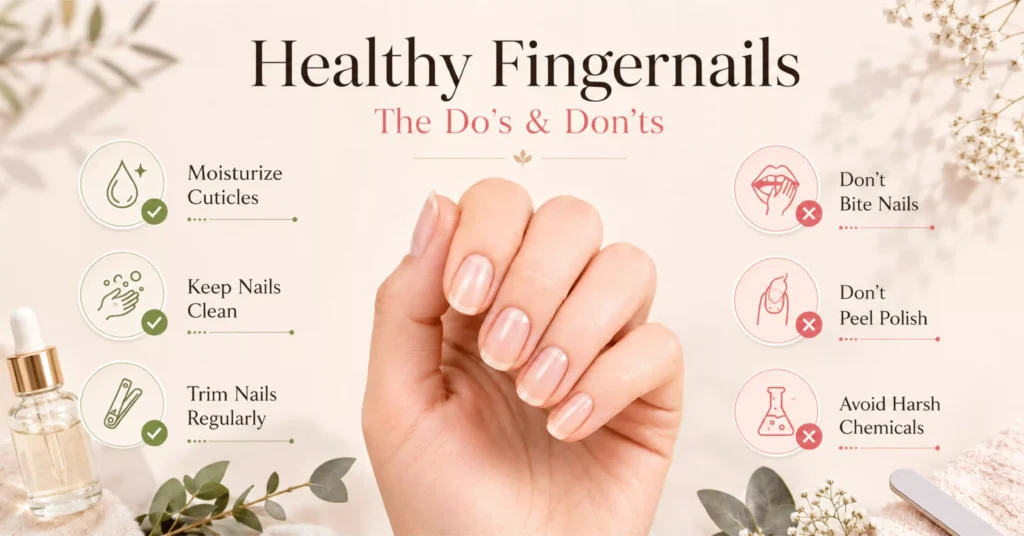
- Never peel product off. It takes layers of the nail plate every single time.
- Always use a base coat as a barrier between pigment and nail.
- Keep product off your skin – the single most effective allergy prevention there is.
- Take breaks between sets when nails feel thin, flaky or tender.
- Wear SPF or fingerless UV gloves when curing, at home or in a salon. Both lamp types emit UVA.
The Technique Gap – and How to Close It
Nail technicians aren’t simply faster than you. They follow a sequence you probably don’t.
The full professional prep order
- Shape the free edge.
- Push back the cuticle and clear non-living tissue from the nail plate.
- Dust off thoroughly.
- Dehydrate the nail plate.
- Apply primer (acid-free for natural nails).
- Thin base coat, cap the free edge, cure fully.
- Two thin colour coats, capping and curing between each.
- Top coat, cap the free edge, cure fully.
- Cuticle oil.
Steps 4 and 5 are the ones home users skip, and they’re the ones that determine whether anything bonds. Skipping dehydration leaves oil on the plate. Skipping primer compounds it on oily nail beds. Applying thick coats means the lamp can’t cure the bottom layer – which costs you wear time and raises the allergy risk described above.
The three purchases that actually change your results
1. A lamp properly matched to your gel system. This is the single highest-impact upgrade for most home users. Many bundled starter lamps are underpowered or mismatched to the formula, which produces chronically under-cured product.
2. A nail dehydrator. Cheap, tiny, and responsible for more wear time than any polish upgrade.
3. An acid-free primer. Especially if your nails run oily and gel lifts on you within days.
Everything past those three is polish selection and the patience to keep layers thin.
When Each Option Genuinely Wins
Choose the salon when
- The result needs to be flawless — a wedding, a shoot, anything photographed closely.
- You’re trying acrylics or extensions for the first time. Watch a professional do it before attempting it yourself; you’ll learn what correct application looks like.
- Your nails are damaged and you need someone trained to assess what’s happening.
- Time is genuinely scarce. Precision under pressure at your kitchen table at 11pm is not a realistic plan.
- You want the experience, not just the outcome. That’s a legitimate reason and doesn’t need justifying with math.
Choose DIY when
- You’re on a biweekly or monthly schedule. The annual arithmetic is decisive.
- You want press-ons for an event or holiday, where short wear is fine and convenience is the point.
- You’re topping up between salon visits with regular polish – this extends a professional set without paying for a new one.
- You enjoy the process. Plenty of people do it because it’s an hour of quiet, not because it’s cheaper.
A Quick Decision Table
| Your situation | Better option |
|---|---|
| Gel every 2 weeks | DIY |
| Gel every 4–6 weeks | Either; DIY still saves |
| Nails done 2–4 times a year | Salon |
| Want acrylics or extensions | Salon |
| Hands in water all day | Either – but choose polish or press-ons over gel |
| Wedding, event, holiday | Salon |
| Learning, and enjoying it | DIY |
| Damaged or painful nails | Salon, or take a break entirely |
Common Mistakes That Skew the Comparison
- Comparing menu price to menu price. Add the tip to the salon figure and amortise the kit cost on the DIY side, or the comparison is meaningless.
- Counting the kit as a per-manicure cost forever. It’s a one-off. By set four it’s noise.
- Blaming the polish for a prep failure. Buying a second, pricier kit rarely fixes a technique problem.
- Assuming DIY means gel. Regular polish and press-ons are legitimate home options with much lower barriers.
- Ignoring your own honesty about frequency. A $130 kit used twice is worse value than the salon. Buy for the habit you actually have.
- Treating salon prices as national. The same service can differ by more than double between states.