Your nails do a lot of quiet work — protecting your fingertips, helping you grip, pick, and scratch — and they often hint at what’s going on with the rest of your health. Most of the time, keeping them healthy isn’t about expensive treatments. It comes down to a handful of small daily habits, and avoiding a few common mistakes that quietly wreck them.
Here’s a clear rundown of what to do, what to skip, and when a nail change is worth a doctor’s visit.
What Healthy Nails Actually Look Like
Healthy nails are smooth, fairly uniform in color, and free of deep ridges, pits, or dents. Nails are made of layers of a protein called keratin, and when they’re in good shape the surface looks even and the nail stays firmly attached to the skin underneath.
A few harmless quirks are normal. Faint vertical ridges running from the cuticle to the tip tend to show up more with age, and the occasional white spot usually just means the nail took a small knock weeks ago. What’s worth paying attention to is a new or lasting change — those are covered near the end.
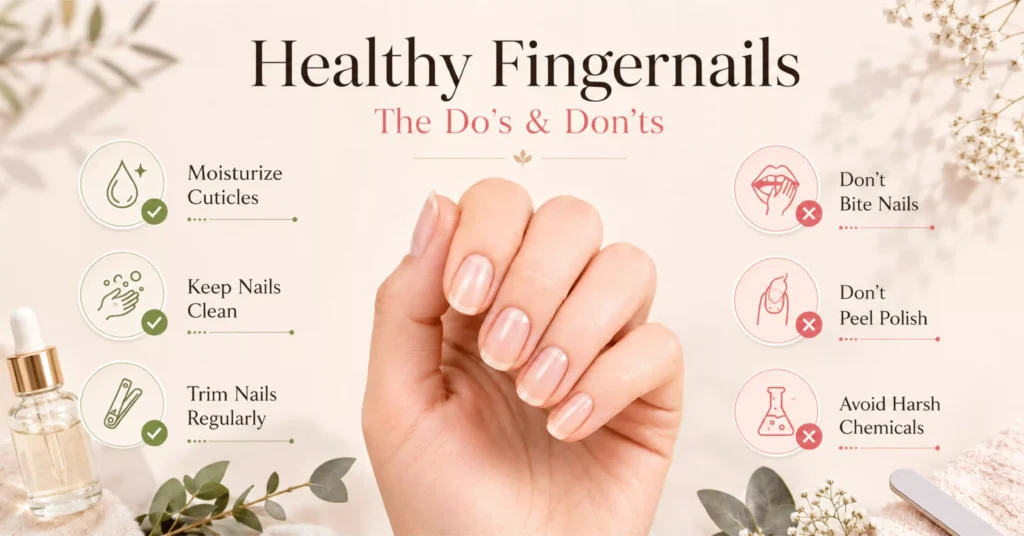
The Do’s
Keep your nails clean and dry. Bacteria and fungi love a damp environment, so drying your hands and nails thoroughly after washing is one of the simplest ways to prevent infection.
Trim straight across, then round the corners gently. Use sharp clippers or nail scissors, cut straight, and soften only the very tips into a gentle curve. This keeps the nail strong and lowers the chance of ingrown edges.
File in one smooth direction with a good file. A glass or crystal file leaves a cleaner, sealed edge than a rough cardboard emery board, which can cause tiny tears that turn into splits and peeling.
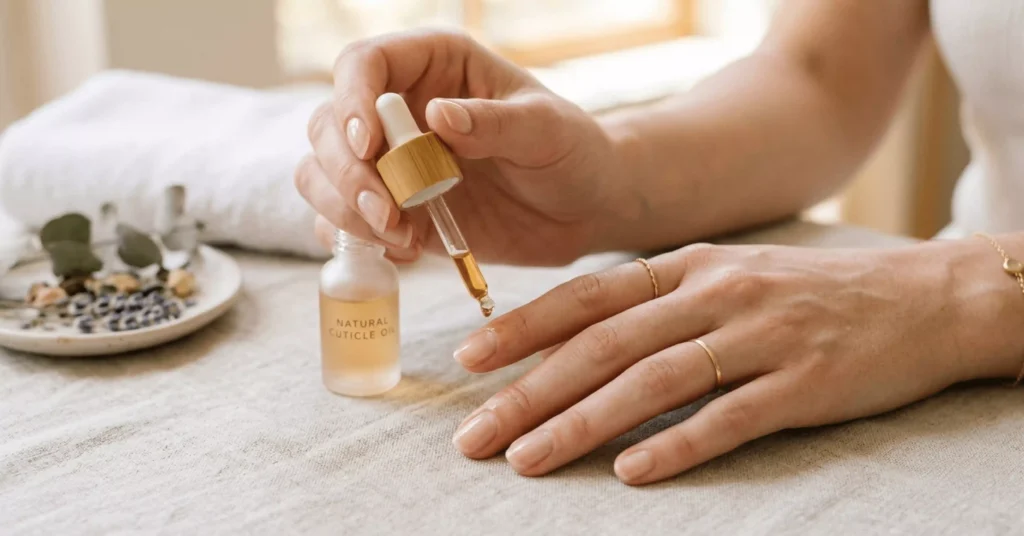
Moisturize — including your nails and cuticles. Hands take a beating from soap and weather. Rub in a hand cream and a drop of cuticle oil daily, especially after washing, to keep nails flexible and cuticles from drying and snagging.
Wear gloves for water and chemicals. Nails absorb water far more readily than skin, and repeated wet-dry cycles weaken them. Pop on rubber gloves for dishes, cleaning, and gardening.
Use a base coat under polish. It creates a barrier that prevents staining and gives color something to grip, so your manicure lasts longer.
Give your nails the occasional break. Going polish-free for a few days now and then lets you check the nail underneath and keep an eye on its condition.
Eat reasonably well. Nails are built from protein, so a balanced diet with enough protein, iron, and overall nutrients supports healthy growth. (More on supplements in the FAQ.)
The Don’ts
Don’t bite your nails or pick at the skin around them. It damages the nail bed, opens the door to infection, and can even spread warts. If it’s a habit, a bitter-tasting polish can help you break it.
Don’t cut your cuticles. This is the big one. The cuticle is a living seal that keeps bacteria and fungi out of the nail’s growth area. Cutting it removes that protection. It’s fine to gently push cuticles back after a shower or a dab of cuticle remover — just don’t trim them away.
Don’t use your nails as tools. Opening cans, peeling stickers, prying lids — all reliable ways to chip, split, or lift a nail.
Go easy on acetone remover. Acetone is drying. Limit how often you use polish remover and reach for an acetone-free formula when you can.
Don’t over-buff. A light buff to smooth the surface is fine occasionally, but buffing often thins and weakens the nail plate over time.
Don’t ignore changes that stick around. A nail issue that won’t resolve, or comes with other symptoms, deserves a proper look rather than wishful thinking.
When to See a Dermatologist
Most nail problems are minor, but a few changes are worth getting checked by a primary care doctor or dermatologist:
- A color change to the whole nail, or a new dark streak running down it
- A change in nail shape, such as curling, or nails getting noticeably thinner or thicker
- Pits, dents, or grooves appearing in the surface
- The nail pulling away from the skin
- Bleeding, swelling, or pain around the nail
- Nails that simply stop growing
If you have diabetes or poor circulation, it’s especially worth seeking treatment for any nail problem early, since infections can be more serious.
Frequently Asked Questions
Do nails need to "breathe"?
Not in the literal sense — nails get their oxygen and nutrients from your blood, not the air. That said, occasional polish-free days are still a good idea so you can check the nail’s health and let it recover from any drying products.
Does biotin really make nails grow faster?
The evidence is mixed. Biotin may help people who are genuinely deficient, but for most people there’s limited proof it speeds growth or strengthens nails dramatically. Talk to a doctor before starting any supplement rather than assuming more is better.
How fast do nails grow?
Fingernails grow roughly 3 millimeters a month on average, so it takes about six months to fully replace a nail and even longer for toenails. This is why nail strengtheners and routines need patience – you’re waiting for new, healthier nail to grow all the way out.
Final Thoughts
Healthy nails really do come down to consistency: keep them clean and dry, moisturize, leave your cuticles alone, protect them from water and chemicals, and don’t use them as tools. Do that, and you’ve handled most of what matters.
If you want to build these habits into a proper routine, check out our step-by-step at-home nail care guide, our dermatologist-backed tips for stronger nails, and our guide to caring for your specific nail type.
This article is general information, not medical advice. For any nail change that worries you, see a board-certified dermatologist.