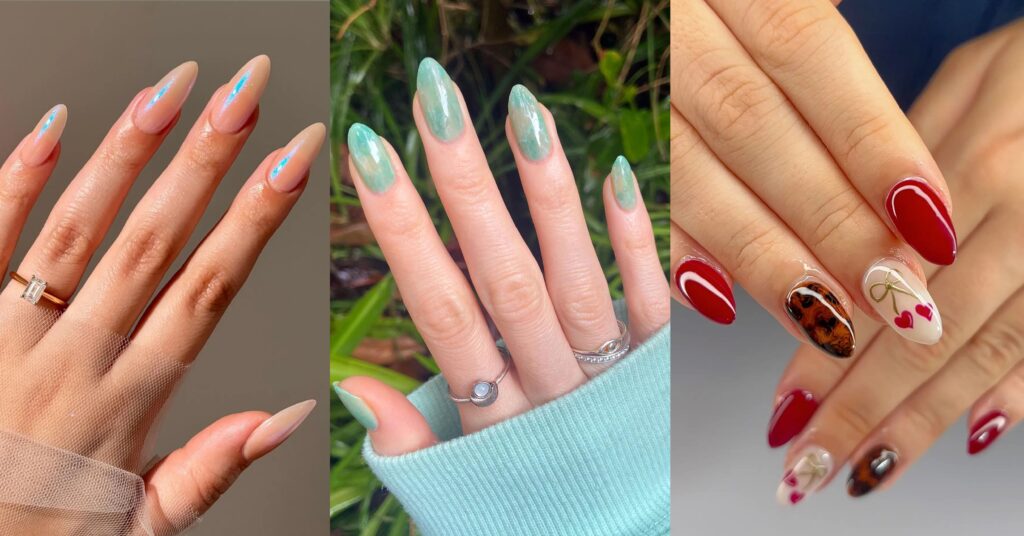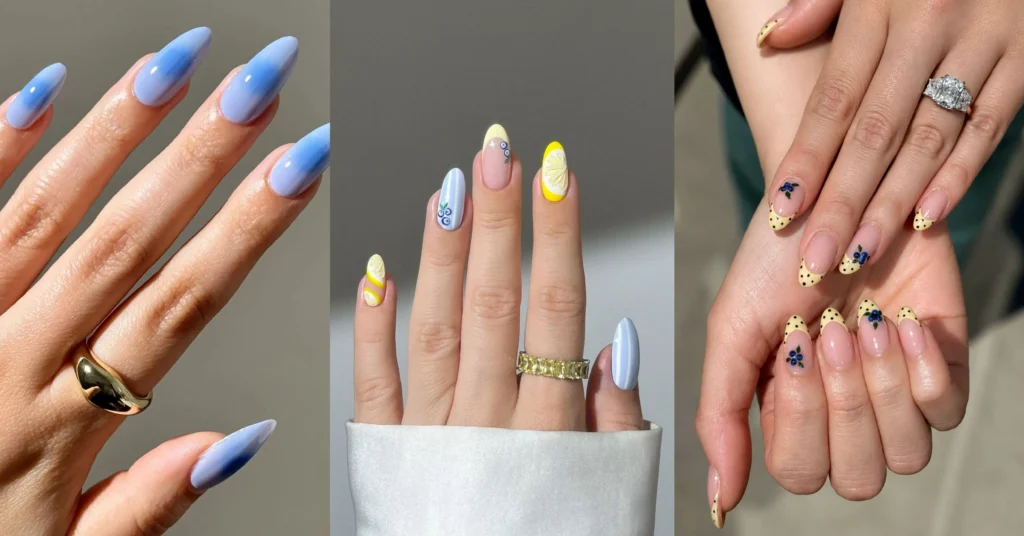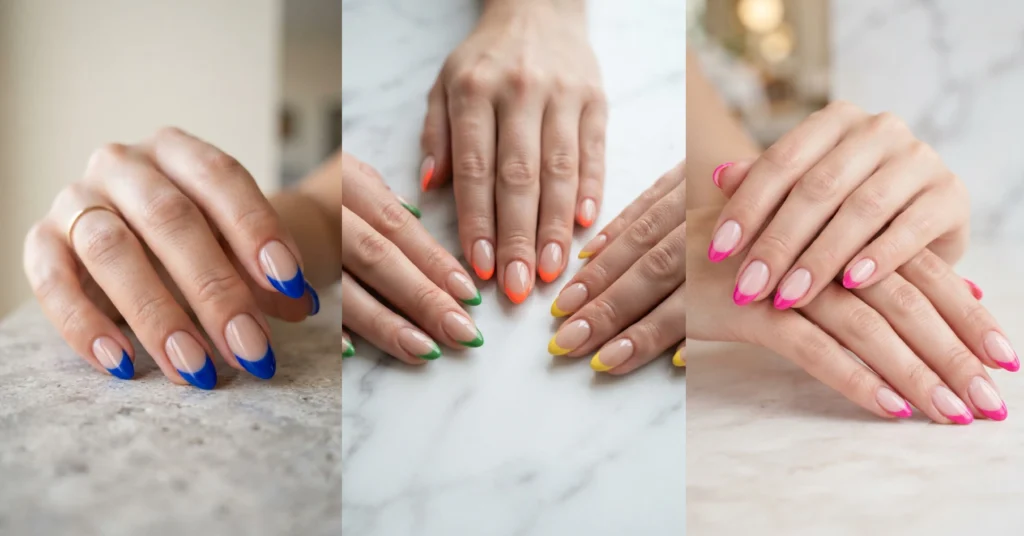
There is a moment every nail appointment has in common. You scroll to the saved photo, turn your phone around, and say some version of “this one, but is it going to look good on me?”
Bright French tips are where that question gets loud. A white tip is safe – it goes with everything and flatters everyone. Swap that white for hot pink or electric blue and suddenly the manicure has an opinion. Get the shade right and your hands look longer, tanner, more expensive. Get it wrong and the color sits on your nails like it belongs to someone else.
This guide is the part Pinterest leaves out. Not just what bright French tip nails look like, but which pinks and blues suit which skin tones, which shades need short nails versus long, and how to paint a smile line that doesn’t wobble on your dominant hand.
What Are Bright French Tip Nails?
Bright French tip nails are a French manicure where the tip along the free edge is painted in a saturated color – hot pink, cobalt blue, neon orange – instead of the traditional white, usually over a sheer nude, milky, or clear base. The shape stays classic; only the color changes.
That single swap is why the style keeps spreading. The French manicure gives you a built-in structure – a defined base, a defined tip, a curved line between them – so a bright color has somewhere to sit instead of flooding the whole nail. It reads as designed rather than loud. Celebrity manicurist Brittney Boyce and Paintbox creative director Mabelyn Alva have both described colored and chrome French manicures as a trend with real staying power rather than a passing season, with bright pink and neons spiking through summer.
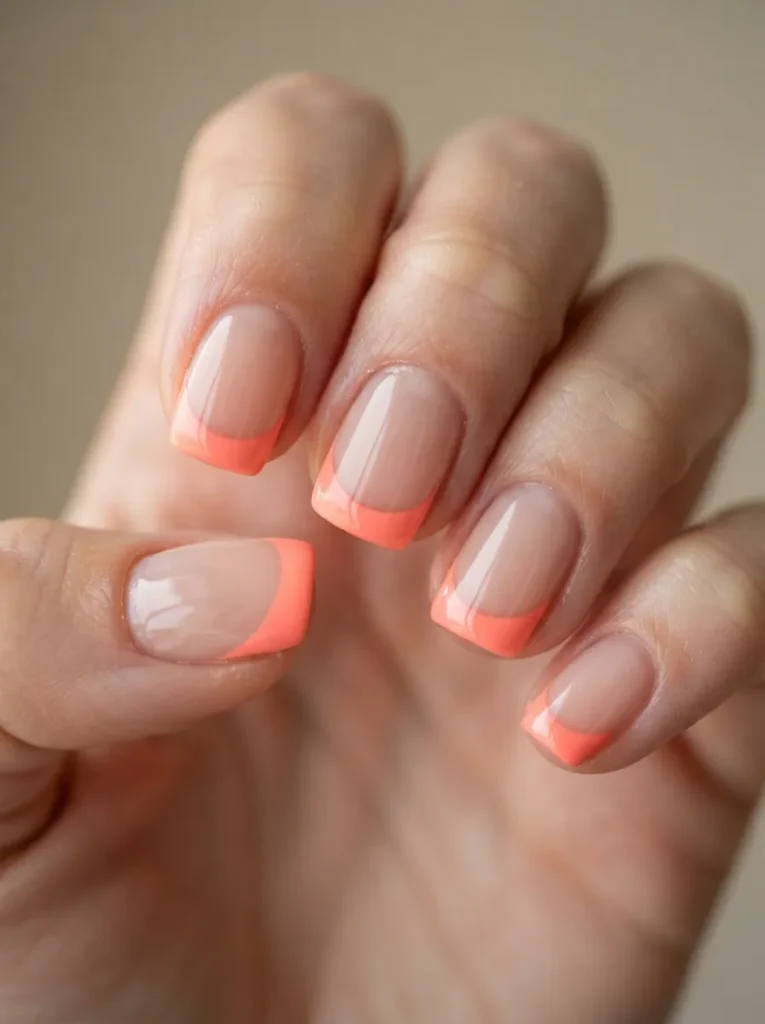
The curved boundary where the base meets the tip has a name worth knowing: the smile line. Almost everything that makes a bright French tip look salon-quality or homemade comes down to that one curve.
Bright Pink French Tip Nails
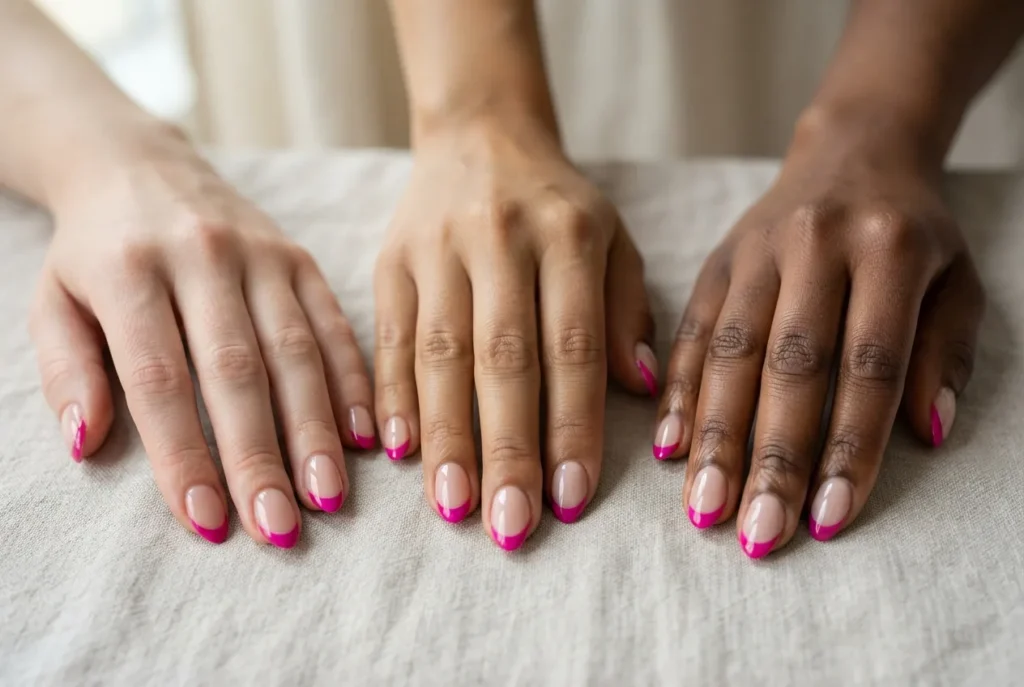
Bright pink French tip nails are the most forgiving entry point into colored tips, because pink already lives in the natural nail – a saturated pink tip reads as an amplified version of your own nail bed rather than a costume.
That familiarity is exactly why “bright pink french tip” shows up in so many saved boards. It’s the shade people request when they want something, but don’t want to explain the something to their family, their office, or a wedding photographer.
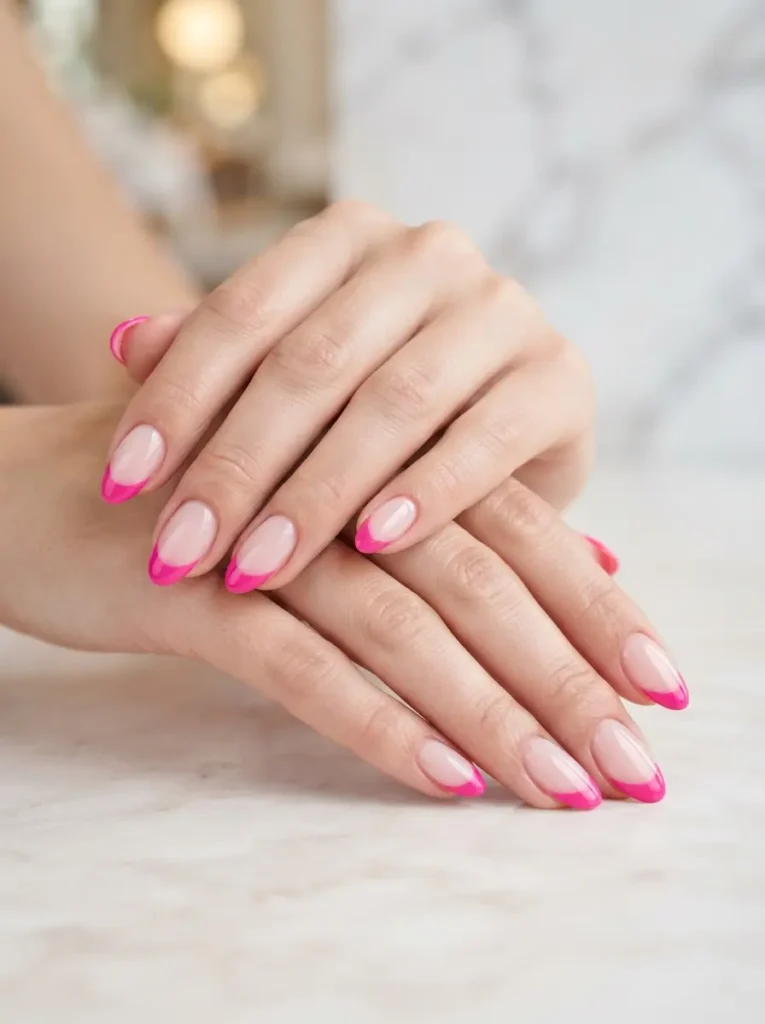
But “bright pink” covers a lot of ground, and the versions behave very differently on the nail.
Hot pink is the workhorse – dense, blue-leaning, opaque in two coats. It’s the shade that photographs closest to how it looks in real life, which matters if you’re recreating a saved image.
Bubblegum pink is softer and warmer. On short nails it’s gentle enough to wear daily; on long extensions it can tip into costume territory if the band is thick, so keep the tip thin.
Neon fuchsia is the loudest and the trickiest. Neon pigments are notoriously streaky — the formula that makes them glow also makes them dry unevenly. Neons almost always need a white or opaque base layer underneath the tip to stop the color looking patchy over your nail bed.
Magenta sits between pink and purple and is the most underrated of the four. It suits deeper skin tones beautifully and looks less “summer only” than neon, so it carries into autumn without feeling out of season.
A detail worth stealing: a bright pink tip over a milky white base rather than a sheer nude one. The milky base cools the whole nail down and makes the pink land harder. It’s the difference between a pink tip and a pink tip that people ask about.
Which Bright Pink Should You Actually Pick?
| Shade | Best on | Coats needed | Watch out for |
|---|---|---|---|
| Hot pink | Any length, any undertone | 2 | Very little – this is the safe one |
| Bubblegum | Short and medium nails | 2–3 (sheerer formula) | Looks washed out on very pale hands |
| Neon fuchsia | Medium to long, tanned skin | 2 over a white base | Streaks badly without the base layer |
| Magenta | Medium to deep skin tones | 2 | Can read purple under warm indoor light |
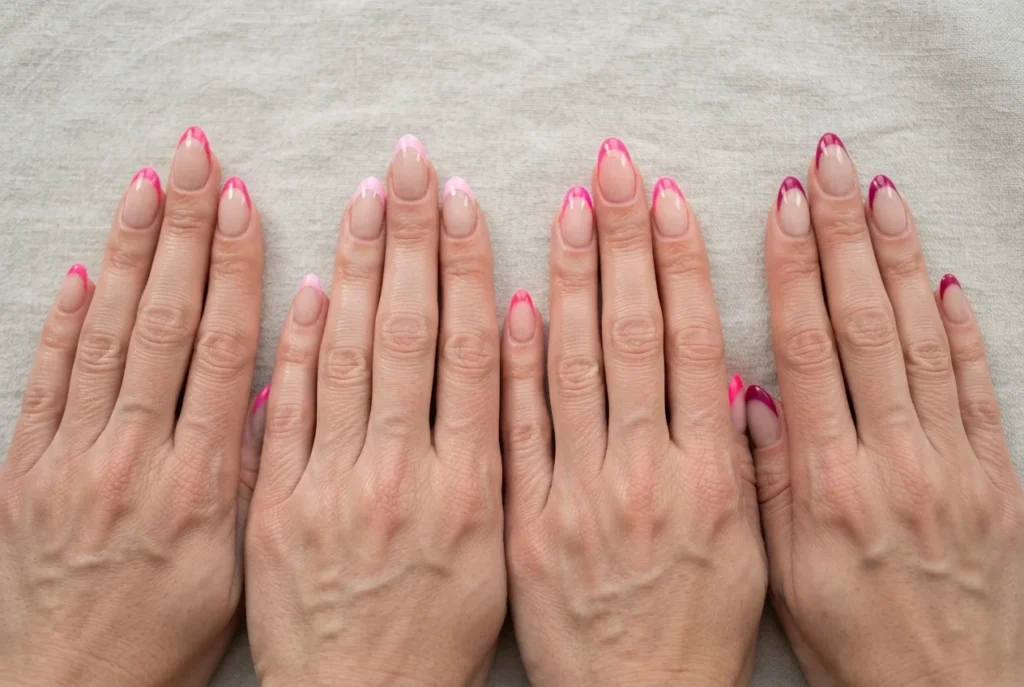
Bright Blue French Tip Nails
Bright blue French tip nails are the boldest mainstream option, because blue is the one color with no natural counterpart in the nail – nothing about your hand suggests blue, so the tip reads as a deliberate design choice from across a room.
Search interest tells the same story: “bright blue nails” and “bright blue french tip” get saved constantly, and they’re the two most likely to be shown to a nail tech as a screenshot rather than attempted at home. There’s a reason for that, and it’s not difficulty. It’s staining.
Blue pigments are among the worst offenders for staining natural nails, particularly if you skip base coat or wear a set for four weeks. If you’re doing a bright blue French tip on natural nails, a proper base coat isn’t optional maintenance advice – it’s the thing standing between you and a faintly grey nail bed for a month.
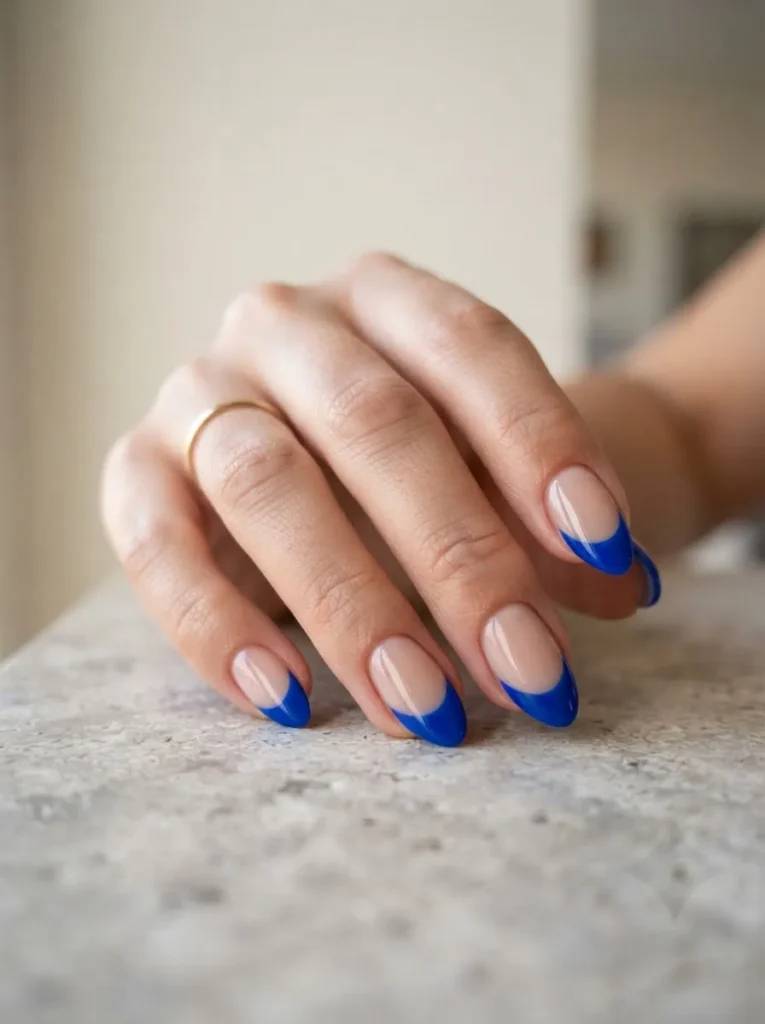
Cobalt is the shade most people mean when they say bright blue. Deep, slightly warm, fully opaque in two coats. It looks expensive on almost everyone and it’s the most photogenic of the blues.
Electric or azure blue is brighter and cooler, closer to a neon. It sings on tanned and deeper skin and can look slightly harsh against very pale, pink-toned hands unless you soften the base to a milky white.
Sky blue is the sleeper option. It’s pale enough to wear as a micro French on short natural nails without any drama, and it’s the version most likely to survive a conservative workplace.
Teal and turquoise blur the line between blue and green, and they’re the most flattering brights for warm and olive undertones – the hint of green in the pigment picks up the warmth in the skin instead of fighting it.
Which Bright Blue Works on Which Nail Length?
| Shade | Short natural nails | Medium/almond | Long extensions |
|---|---|---|---|
| Cobalt | Yes, as a micro tip | Ideal | Ideal |
| Electric blue | Too heavy | Good with a thin band | Statement set |
| Sky blue | Ideal | Good | Can look faded |
| Teal | Yes | Ideal | Good |
Almond, incidentally, is the top trending nail shape searched alongside French tips in 2026 according to TruHue’s search data – and it’s a genuinely good match for blues, because the tapered tip narrows the colored band and keeps a strong shade from overwhelming a short nail bed.
Pink and Blue French Tip Nails: Wearing Both at Once
Pink and blue French tip nails work when one color leads and the other supports – an even 50/50 split across ten fingers is what makes the combination look accidental rather than styled.
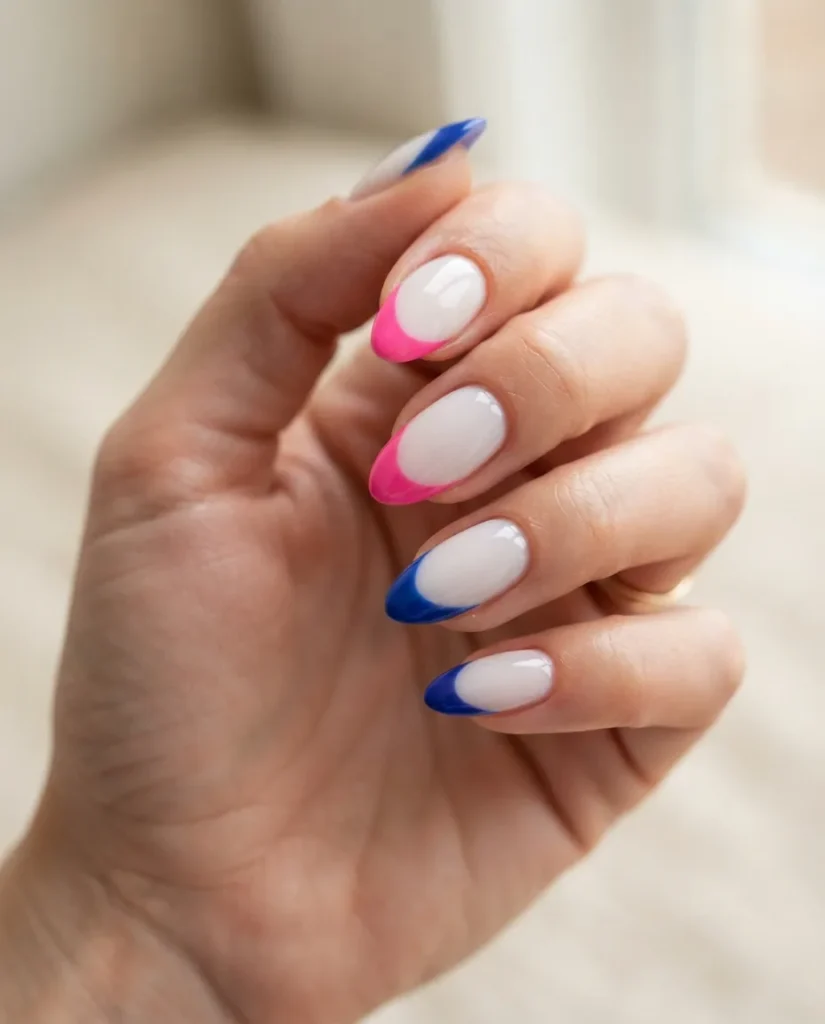
This pairing has quietly become one of the most-saved bright French looks, and there are four ways to do it that actually hold together:
Alternating fingers. Pink tips on the index, middle, and pinky; blue on the ring and thumb. The simplest version, and the easiest to fix if one nail chips.
One accent nail. Nine pink tips, one blue – usually the ring finger. Understated enough for anyone nervous about committing to blue.
Split tip. A single tip painted half pink, half blue, meeting in the middle of the free edge. This one is genuinely difficult freehand and is worth booking a tech for, or buying as press-ons.
Gradient across the hand. Pink on the thumb fading through to blue on the pinky, with a blended shade or two between. The most striking, and the one that most needs the two colors to share an undertone – a warm pink beside a cool electric blue will clash. Pair a blue-leaning hot pink with cobalt, or a warm bubblegum with teal.
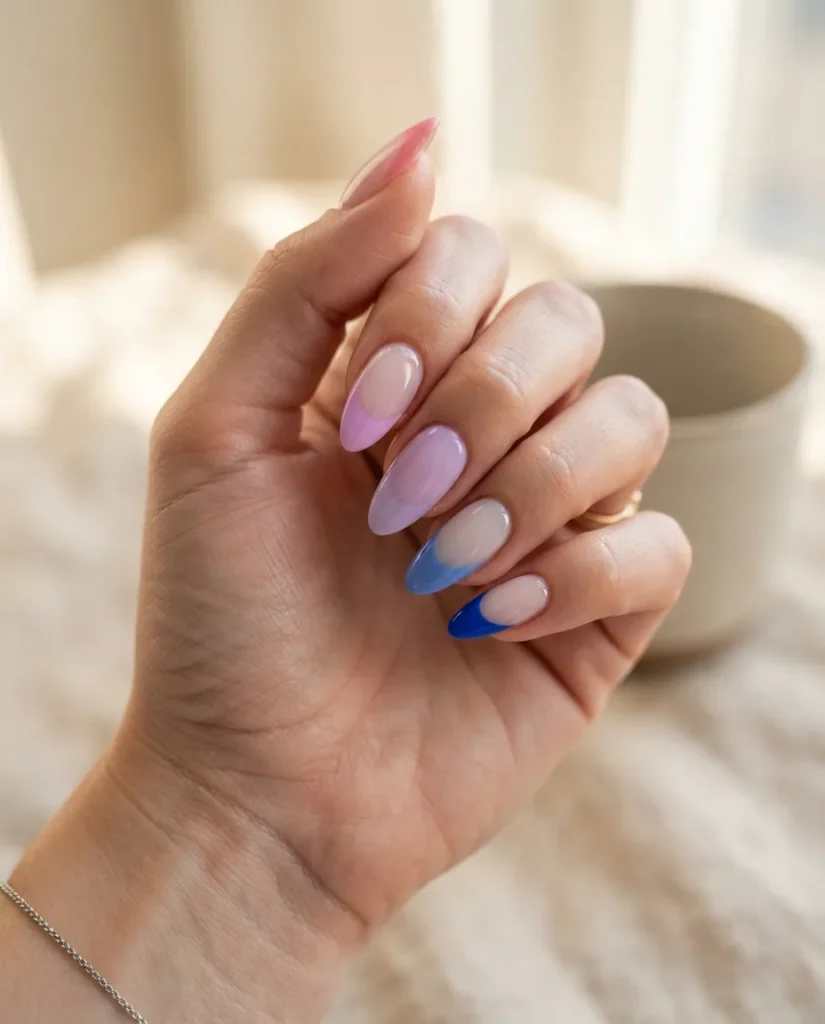
Keep the base identical on every nail. Whatever you do with the tips, one consistent base is what stops a two-color set from looking like two different manicures.
Other Bright Colors Worth Trying
Pink and blue dominate, but three other brights deserve a mention.
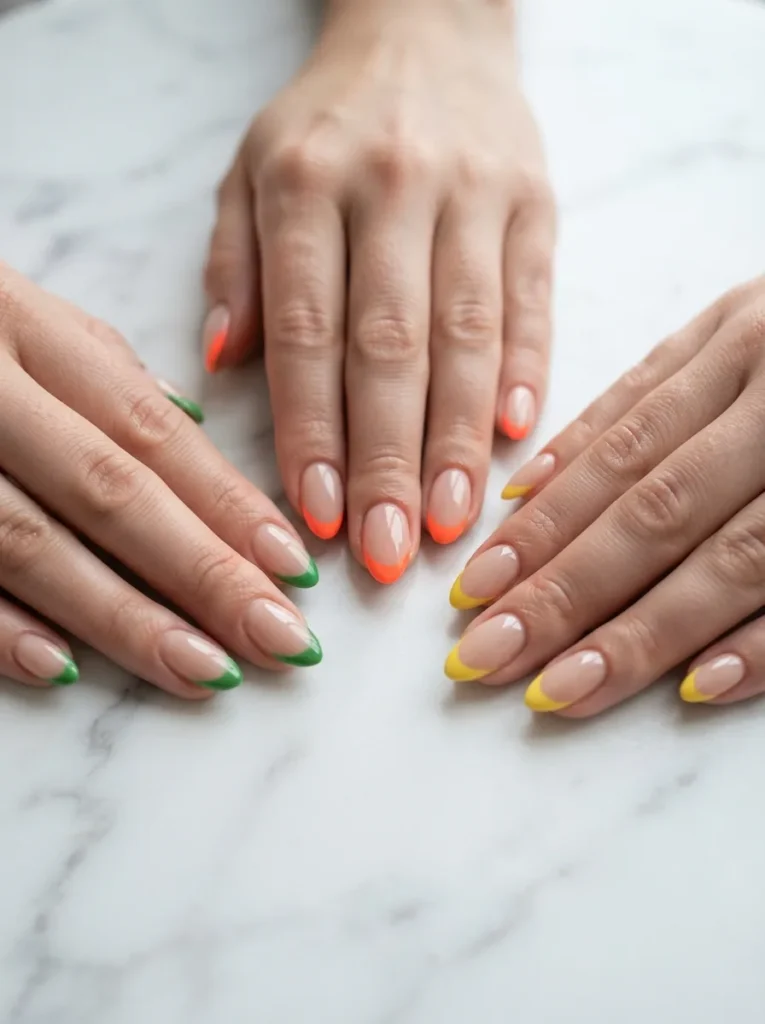
Kelly green is a genuine summer favorite in salons and looks unexpectedly polished with a nude base.
Neon orange is the shade that reads best on tanned skin and worst under office lighting.
Bright yellow is the hardest of all to wear – it needs a white base layer, it exposes any unevenness in the smile line, and it looks best kept as a micro tip on short nails.
Chrome finishes are worth considering across any of these. A chrome powder buffed over a colored tip gives the same bright shade a mirrored surface, which photographs beautifully and hides small imperfections in the line.
How to Choose a Bright Tip That Suits Your Skin Tone and Nail Length
The fastest way to check whether a bright shade suits you is to look at the veins on the inside of your wrist. Blue or purple veins usually mean cool undertones; green veins usually mean warm undertones; a mix means neutral, and you can wear almost anything.
- Very pale skin – the loudest neons can look stark. Cooling the base to milky white bridges the contrast.
- Cool undertones – blue-based brights land best. Cobalt, magenta, hot pink with a blue lean, electric blue.
- Warm undertones – brights with warmth in them. Coral pink, teal, Kelly green, neon orange.
- Neutral undertones – you have the widest range. Start with whatever you keep saving.
- Deep skin tones – saturated, high-pigment shades hold up best. Magenta, cobalt, and neon brights read clearly; very pale pastels tend to disappear.
Nail length matters just as much as color:
- Short natural nails – go micro. A micro French uses a roughly 2–3mm tip line instead of the classic 5mm band, which keeps a bright shade from eating your whole nail. TruHue notes these are specifically designed for shorter nails, and they’re the reason the old “you need long nails for a French” rule no longer applies.
- Medium and almond – the most flexible. Any shade, any band thickness.
- Long extensions – you can carry a thicker band and busier ideas like split tips and gradients, but very pale brights start to look washed out over that much length.
How to Do Bright French Tips at Home (Step by Step)
You can absolutely do this yourself. The honest caveat is that the smile line on your dominant hand takes practice – expect your first two attempts to look uneven, because everyone’s do.
The one decision that matters most: use gel polish if you have a lamp. Highly pigmented gel polish stays wet until it’s cured, which as Mylee’s technicians point out gives you unlimited time to perfect the smile line before it sets. Regular polish starts skinning over in under a minute and punishes hesitation.
- Prep properly. File to shape, gently push back cuticles, wipe the nail with alcohol or a cleanser to remove oil. Bright pigments lift fast off an oily nail.
- Base coat, always. Two thin coats if you’re using blue or neon. This is your stain protection.
- Lay the base color. Sheer nude or milky white, two thin coats, capping the free edge each time.
- Let it dry completely. If you’re taping, this matters enormously – tape applied to soft polish pulls the base right off.
- Choose your smile line method. Freehand with a thin liner brush gives the most natural curve; a 7mm ultra-fine brush produces cleaner edges than the brush that comes in the bottle. Tape or curved guide stickers give more consistency if freehand frustrates you – press the sticker onto the back of your hand once first so it lifts cleanly instead of pulling up your base.
- Paint the tip in two strokes. Start at one side wall and sweep toward the center; repeat from the other side. Two coats thin, not one coat thick. If you’re using neon or yellow, put down an opaque white layer first.
- Clean the line while it’s still workable. Dip a small angled or liner brush in acetone and run it along the outside of the smile line, nail by nail, before moving on. This step is the single biggest difference between homemade and salon-looking.
- Top coat and cap. One generous coat over the whole nail, dragged across the free edge to seal the tip. Cuticle oil once everything is fully dry.
If you’re using tape rather than a brush, peel it while the polish is tacky but not wet – around 60 seconds. Peel too early and the color smears; too late and the tape takes the tip with it.
How Long Do Bright French Tips Last (and What They Cost)
Longevity depends almost entirely on the product, not the color:
| Method | How long it lasts | Typical cost |
|---|---|---|
| Regular polish at home | 5–7 days before chipping | $3–8 per bottle |
| Press-on French tips | 2–3 weeks, often reusable | $10–35 per set |
| Gel polish at a salon | 2–3 weeks | $35–60 |
| Gel-X or acrylic extensions | 3–4 weeks before a fill | $45–65+ |
Those ranges come from licensed nail technicians at Iconix Nail Bar in Houston, who put French tips at roughly $35–$55 depending on whether they’re done on natural nails, gel, or extensions, and from TruHue and PolishPops, who report salon gel French sets at $40–65 with rebooking every 2–3 weeks. Doing it yourself brings a session down to around $16 by PolishPops’ math, once you own the polish.
A note on press-ons: they’re the smartest way to test a bright shade you’re unsure about. You’ll know within a day whether cobalt suits your hands, and you haven’t spent $50 or committed to three weeks of gel removal. File them to your preferred shape after applying — 30 seconds with a file is what stops them looking uniform and fake.
Common Bright French Tip Mistakes (and How to Fix Them)
- The smile line is wobbly on one hand. Almost always the dominant-hand problem. Fix it after the fact rather than during – a liner brush dipped in acetone can carve a clean curve out of a messy one while the polish is still soft.
- The color looks streaky. You skipped the opaque base under a neon, or you applied one thick coat instead of two thin ones. Neons and yellows genuinely need a white layer underneath.
- The tip is thick and blobby. Too much product on the brush, and probably a bottle brush instead of a fine liner. Wipe the brush almost dry before each stroke.
- The tip peels off within days. You didn’t cap the free edge. Every layer – base, color, top coat – should be dragged across the edge of the nail, not stopped short of it.
- Your nails are stained after removal. Blue and neon pigments, no base coat. Not permanent, but it takes weeks to grow out. Base coat every time, without exception.