
Find the nail shape that fits your hands – and survives your week
Most nail shape guides tell you what looks good on a hand model. This one looks at your nail beds, your finger proportions, how strong your nails actually are, and what your hands do all day.
Answer five questions and you get a shape, a safe length in millimeters, a breakage risk score, and the exact sentence to say at your next appointment. It takes about a minute, it’s free, and nothing you enter leaves your browser.
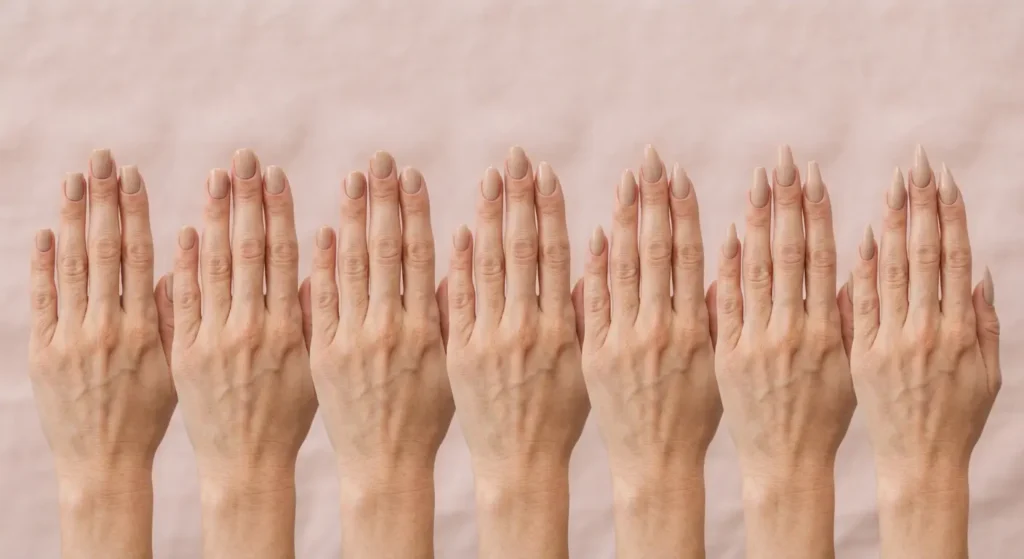
Built on measurements, not vibes
Optional millimeter inputs turn “I think my nail beds are kind of wide” into a real aspect ratio. Measured results carry a higher confidence rating.
Scores durability, not just looks
Every shape gets two scores: how well it flatters your hands, and how likely it is to still be intact in two weeks. The winner has to pass both.
Shows you the shape on a nail
A live vector preview morphs as you answer, rendered at your own nail bed proportions. Try on all seven shapes after you get your result.
Why nail shape is a proportion problem, not a style problem
The reason you keep picking shapes that look wrong is that almost every guide online treats nail shape as a fashion decision. It isn’t. It’s a proportion decision, and proportion is measurable.
Three things determine whether a shape flatters your hands: the ratio of your nail bed’s length to its width, the length of your fingers relative to your palm, and the curve of your cuticle line. A fourth thing determines whether the shape survives the month: the thickness and flexibility of your nail plate, combined with how much physical stress your hands take in an average week.
The two shapes recommended most often – almond and coffin – are the two that fail hardest when either of those factors goes against you. That isn’t a coincidence. They photograph best, images drive recommendations, and nobody in the photograph is doing the dishes.
This tool separates the two questions and answers both.
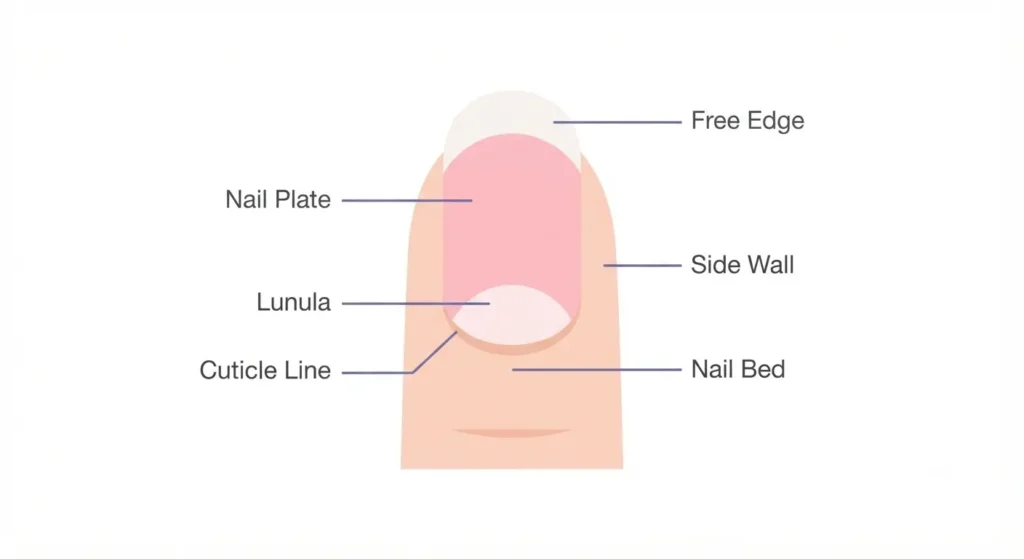
How the nail shape finder works
The finder scores all seven mainstream shapes against your answers on two independent axes.
Fit measures how well a shape works with your anatomy. Nail bed aspect ratio carries the most weight, followed by finger proportion, then cuticle curve. A tapered shape on a wide nail bed scores high, because the taper visually narrows the bed. A flat square tip on that same bed scores low, because a straight edge draws the eye across the full width.
Survivability measures how likely the shape is to last. Nail plate strength carries the most weight, followed by daily hand load, then target length. Corners and points are stress concentrators: at identical nail thickness, a square corner and a stiletto tip both fail before a rounded edge does.
The recommendation is the shape with the best balance of both, calculated using a harmonic mean rather than an average, so a shape can’t win on looks alone. A shape scoring 95 on fit and 20 on survivability lands at 33 overall – which is the correct answer. That shape will look incredible for six days, and then you’ll be filing an emergency repair at your desk.
The full weighting is published on the methodology page.
How to measure your nail bed at home
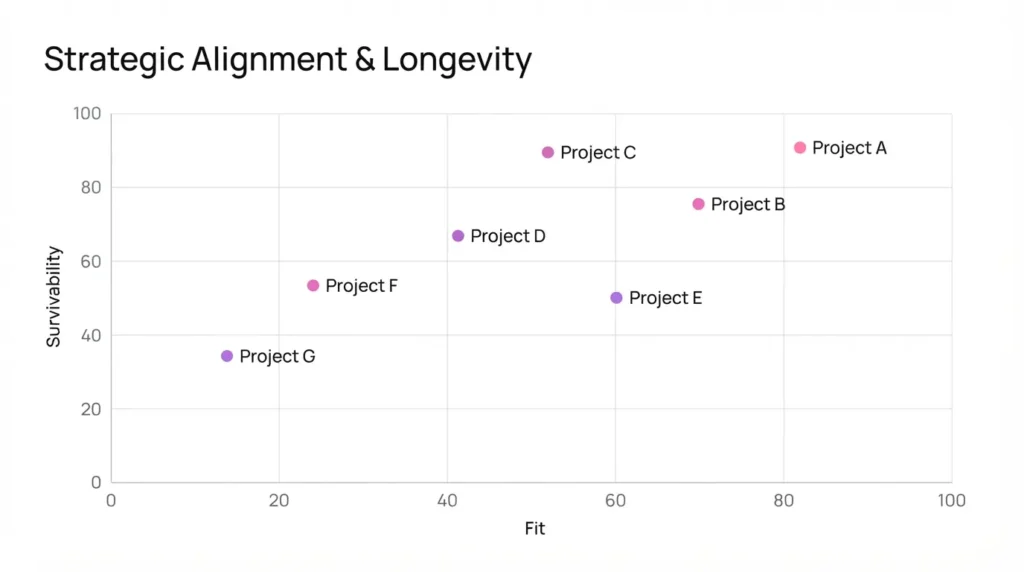
You don’t need calipers. Two minutes and a coin will do.
- Push your cuticles back gently on your index finger with a wooden stick, so the edge of the nail bed is clearly visible. Push – don’t cut.
- Place a coin flat beside your nail, touching the side wall. A US quarter is 24.26 mm across, a 1 euro coin is 23.25 mm, and a credit card is 85.6 mm long. Any of them works as a scale reference.
- Photograph both together from directly overhead, phone parallel to your hand, in even light. Overhead matters – an angled shot distorts the ratio.
- Measure the width at the widest point, side wall to side wall, comparing against the coin in your photo. Any free on-screen ruler app will do this.
- Measure the length from the cuticle line to where the pink nail bed ends and the white free edge begins. Do not include the white tip.
- Divide length by width. That number is your nail bed aspect ratio.
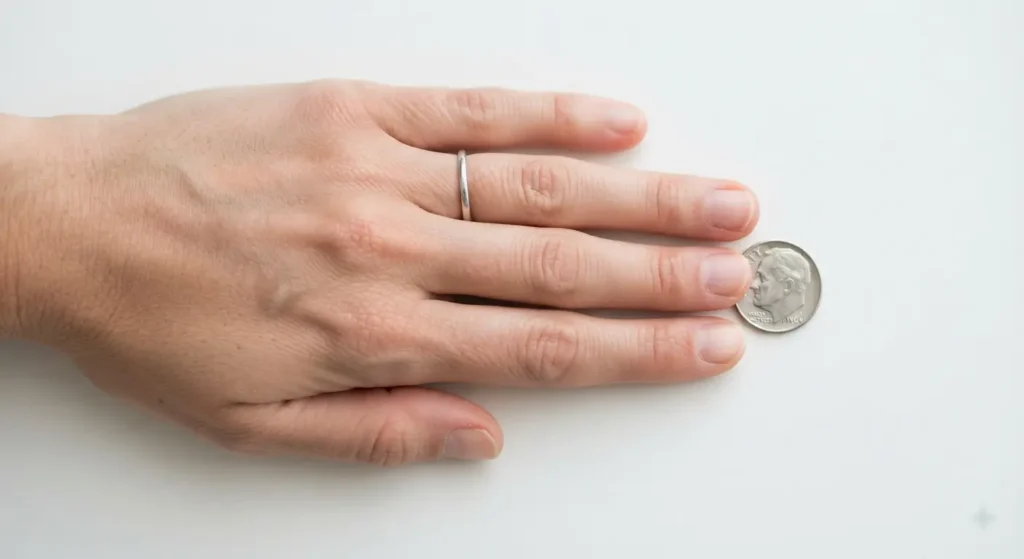
| Aspect ratio | What you have | Shapes that work | Shapes that fight you |
|---|---|---|---|
| Under 0.85 | Wide nail bed | Oval, almond, round | Square, coffin |
| 0.85 – 1.10 | Balanced | Squoval, oval, almond | – |
| 1.10 – 1.35 | Long nail bed | Square, squoval, coffin | Round |
| Over 1.35 | Very long | Square, coffin, stiletto | Round |
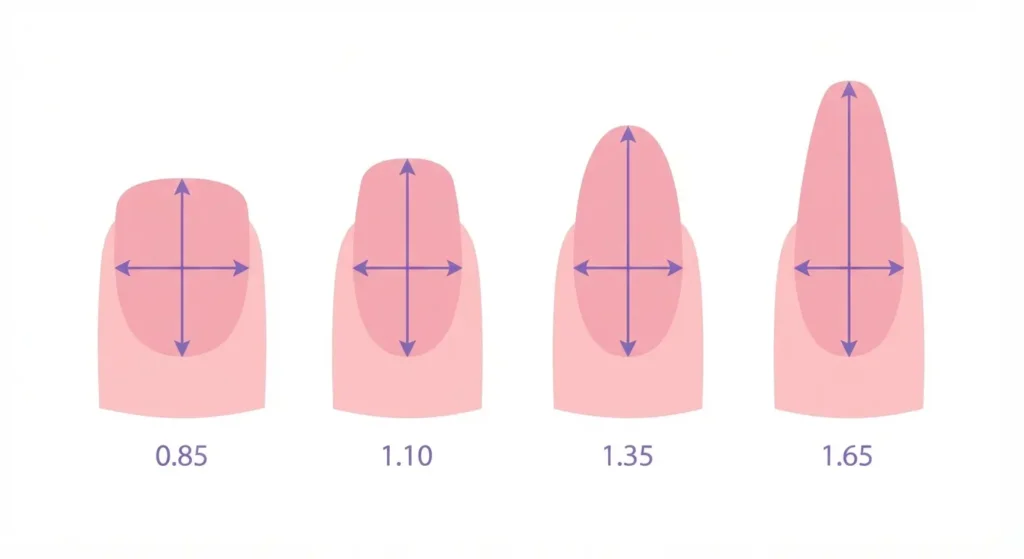
Most people are surprised by their number, because the eye judges nail bed width against fingertip width rather than against nail bed length.
Measure your index finger, not your thumb. Thumbs run wider than the rest of the hand and will skew your result toward wide.
The seven nail shapes, and who each one is actually for:
Square
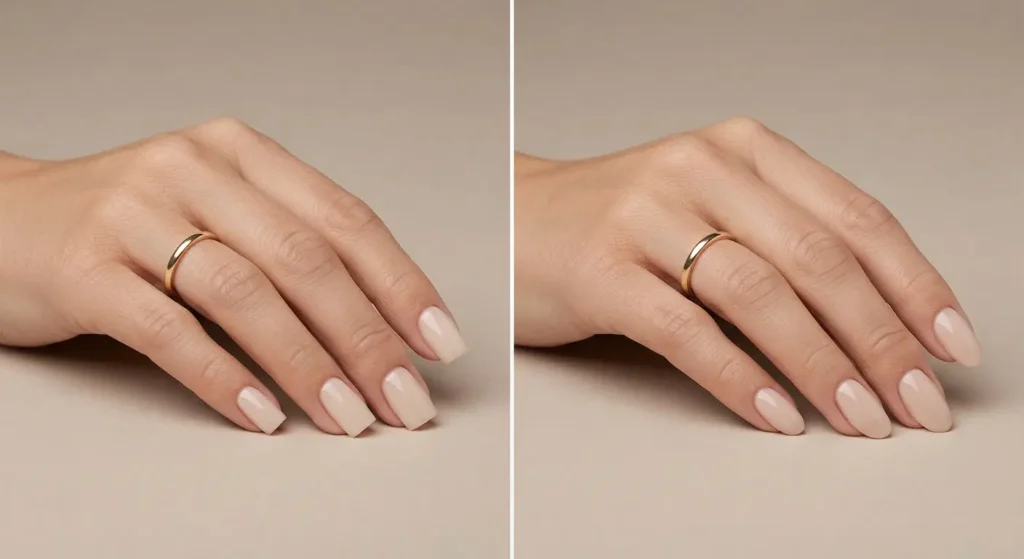
Filed straight across with defined corners and no taper. Maximum surface area for nail art.
Works on: long fingers with narrow nail beds, and anyone whose aspect ratio sits above 1.10.
Fights you if: your nail beds are wide. A straight edge emphasizes full width and makes short, wide nails look shorter and wider.
Durability: strong through the middle, weak at the corners. Those two corners concentrate stress and catch on fabric, hair, and pockets. Maintenance: every 10–14 days.
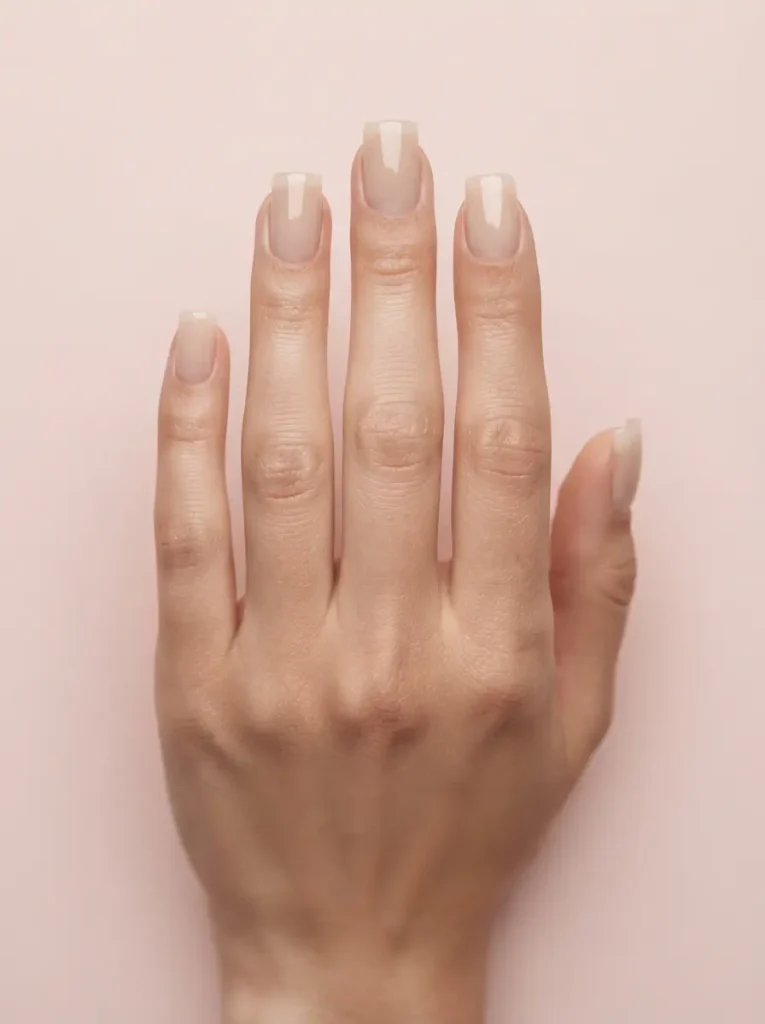
Squoval
A square with the corners filed off at roughly 45 degrees. The most forgiving shape in existence.
Works on: almost everyone. This is the correct default when you aren’t sure.
Fights you if: you want drama. It doesn’t have any.
Durability: the best of the seven. Removing the corners removes the failure points while keeping a square’s structural width.
Maintenance: every 14–21 days, and it still looks fine past that.
If you’re growing nails back from acrylic damage or biting, this is the shape to hold until your nail plate recovers.
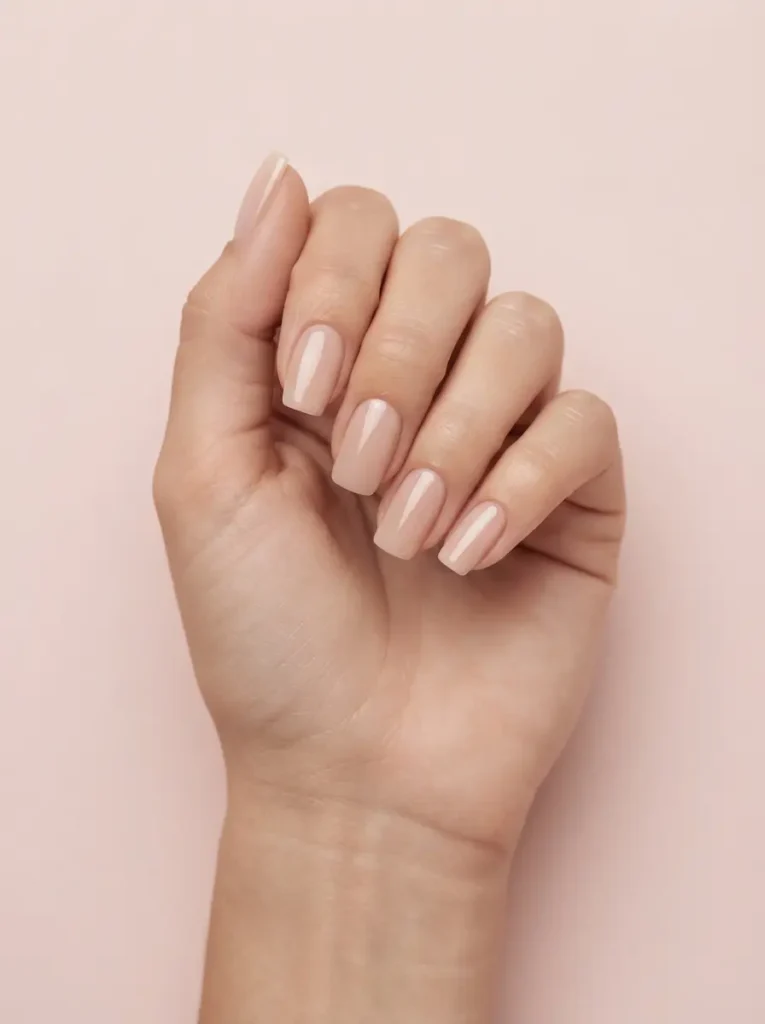
Round
Follows the natural curve of the fingertip with minimal extension. The lowest-maintenance shape available.
Works on: short or wide nail beds, and anyone with genuinely brittle nails. Round elongates short fingers and makes wide nail beds appear thinner.
Fights you if: you want visible length. Round essentially can’t be long.
Durability: effectively unbreakable. No corner, no point, nothing to catch.
Maintenance: every 2–3 weeks, and it grows out gracefully instead of going lopsided.
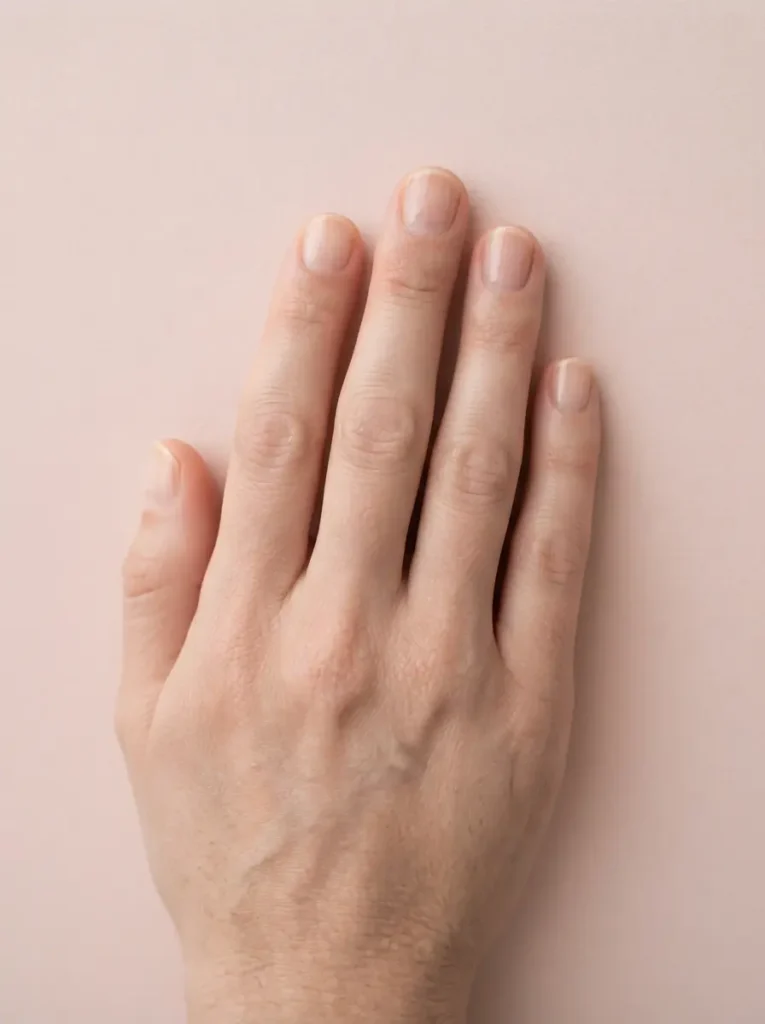
Oval
An egg-shaped curve that mirrors the cuticle line. The classic finger lengthener.
Works on: short fingers, wide nail beds, small hands. The taper narrows the visual width of the bed while the curve draws the eye upward.
Fights you if: you keep your nails very short. Oval needs 2–3 mm of free edge to read as oval rather than round.
Durability: good. Rounded tips distribute stress well, though tapered sidewalls are thinner than a square’s.
Maintenance: every 12–18 days.
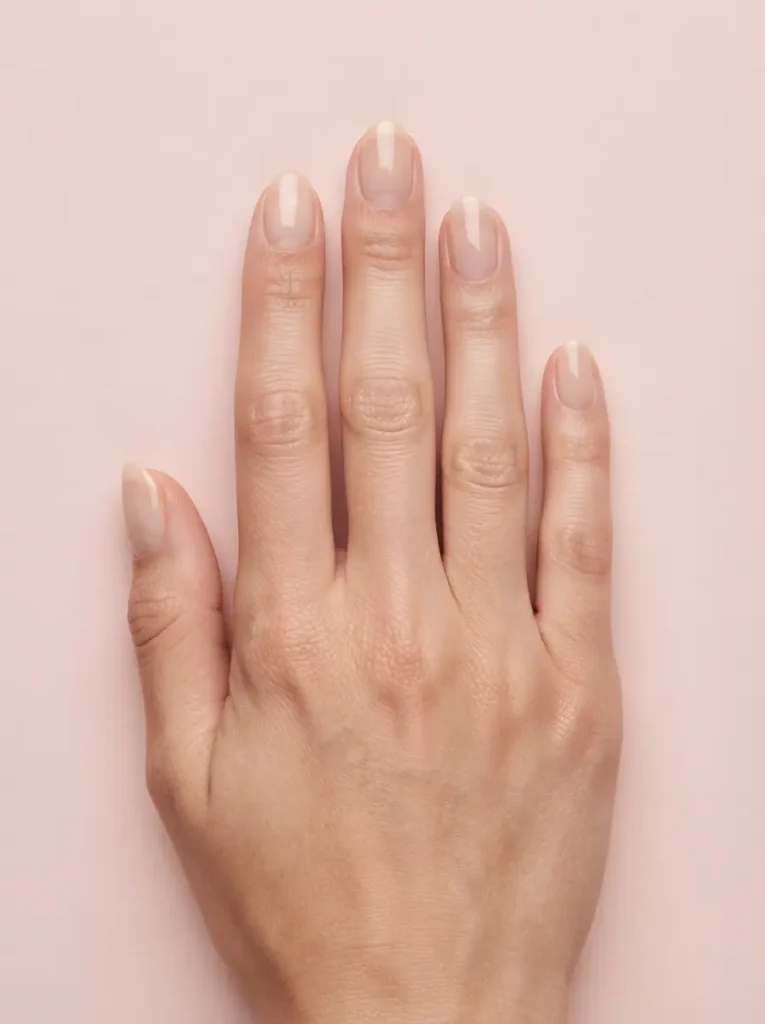
Almond
Tapered sides meeting in a soft, rounded peak. The most requested shape in salons, and the one most often recommended to people it doesn’t suit.
Works on: narrow to balanced nail beds with enough length to build the taper. Genuinely excellent on short fingers.
Fights you if: your nails are thin or peeling. The taper removes material from the sidewalls, which is exactly where a nail resists lateral force. Durability: moderate at best on natural nails. This is the shape most likely to break in the tool’s model.
Maintenance: every 10–14 days, with a strengthening base coat throughout.
If almond is your goal and your nails aren’t ready for it, the finder will say so and give you a path to get there.
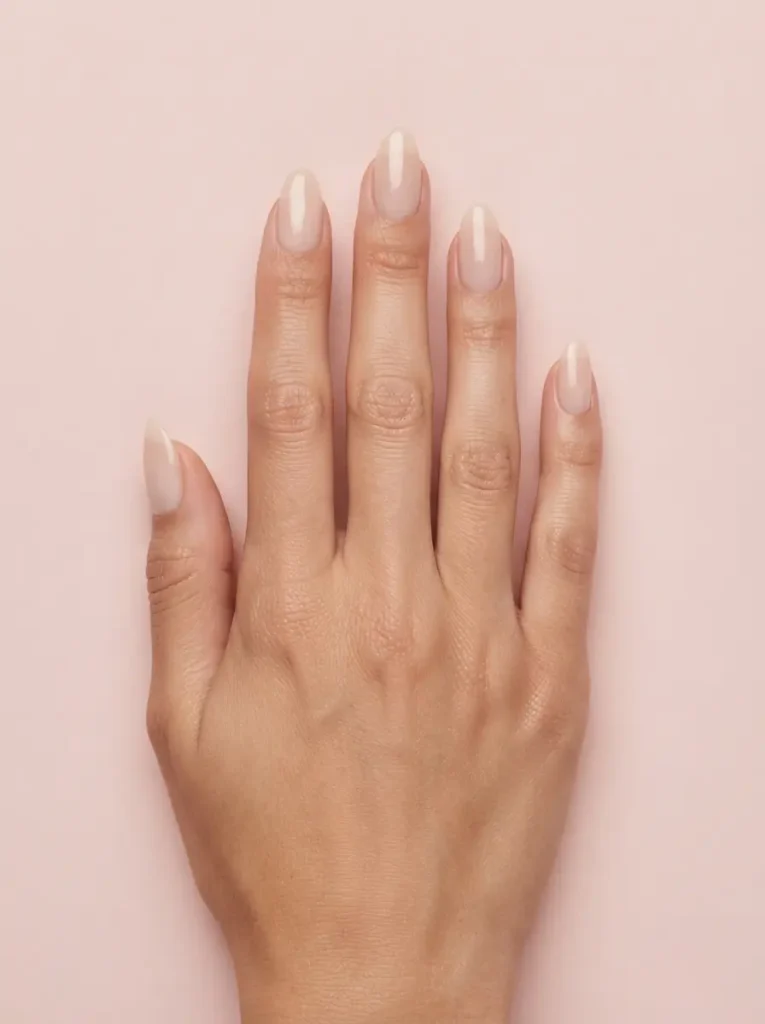
Coffin (Ballerina)
Tapered sides that stop at a flat, squared tip. Needs real length to read correctly.
Works on: long nail beds, and realistically only on extensions. Natural nails rarely hold the required length and taper at the same time.
Fights you if: you want a natural-nail manicure. This shape lives on gel and acrylic.
Durability: poor on natural nails. You’re combining a taper (thin sidewalls) with a flat tip (two corners) – both failure modes at once.
Maintenance: refill every 2–3 weeks without exception, or the apex migrates and the whole set goes off balance.
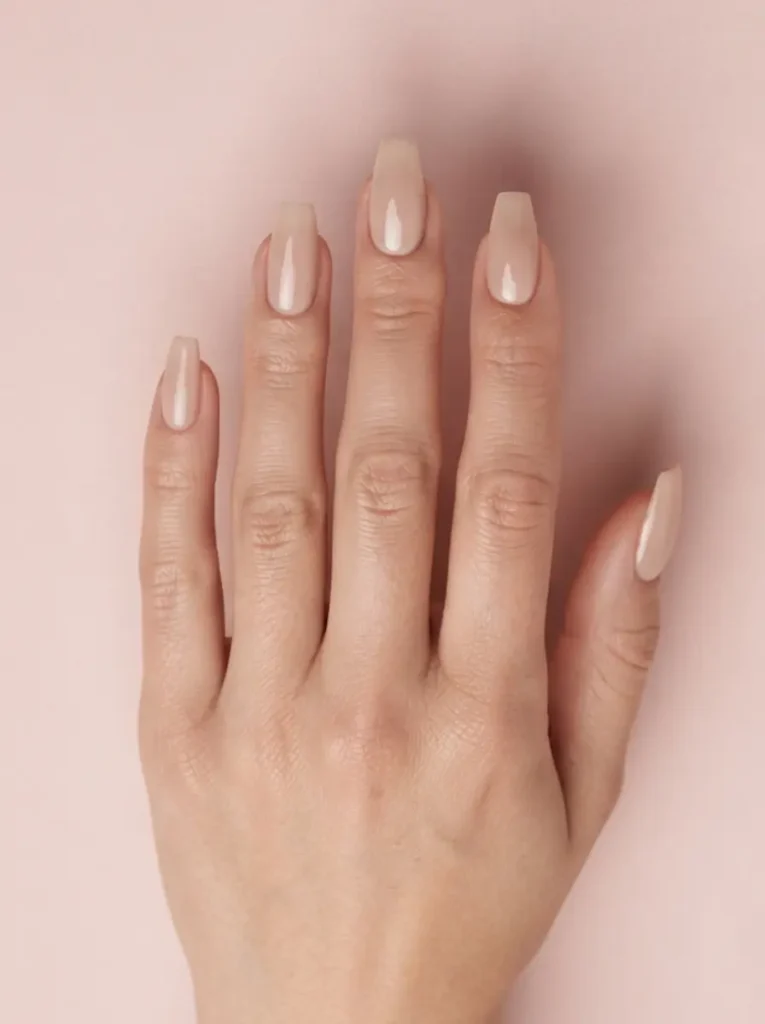
Stiletto
A long, aggressive taper to a single sharp point. Maximum drama.
Works on: long nail beds, on hard gel or acrylic, for people who genuinely adjust their daily habits.
Fights you if: you type, cook, lift, drive a manual, or have small children. Which is most people.
Durability: the weakest of the seven, by a wide margin.
Maintenance: every 2 weeks, strictly.
Stiletto isn’t a bad shape. It’s a shape with a price, and the price is behavioral: buttons with knuckles, zips with the pad of your finger, phone with the flat of your fingertip.
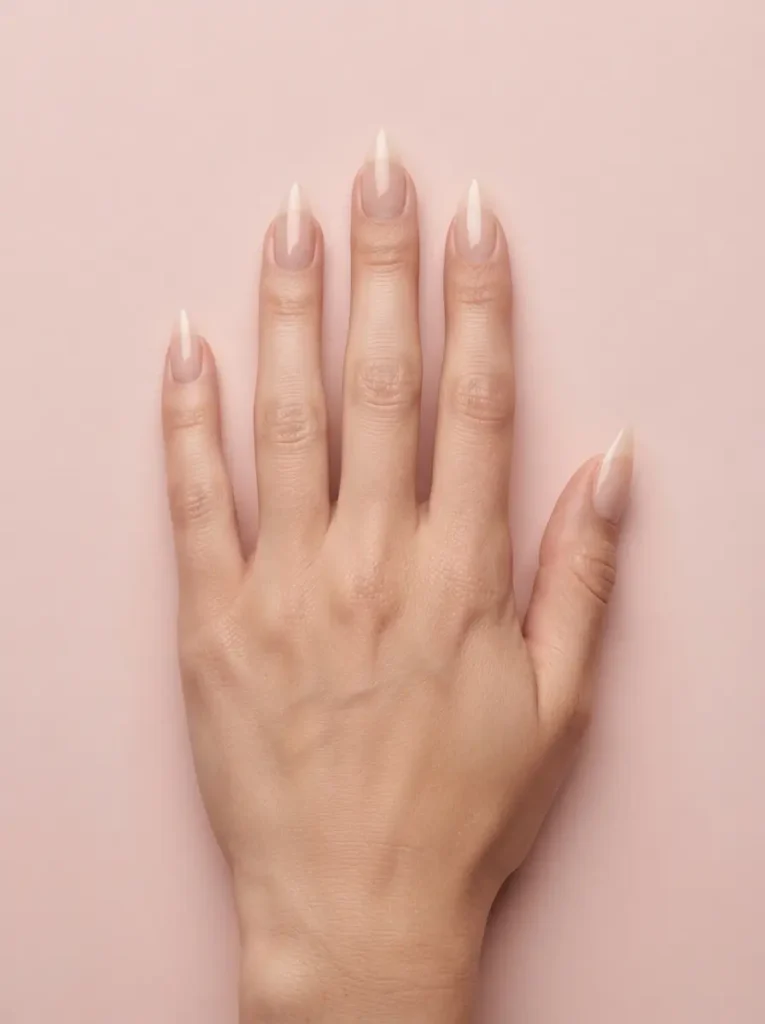
Matching nail shape to hand type
Your ideal shape sits at the intersection of finger length, nail bed width, and current nail strength. Here’s how the common combinations resolve.
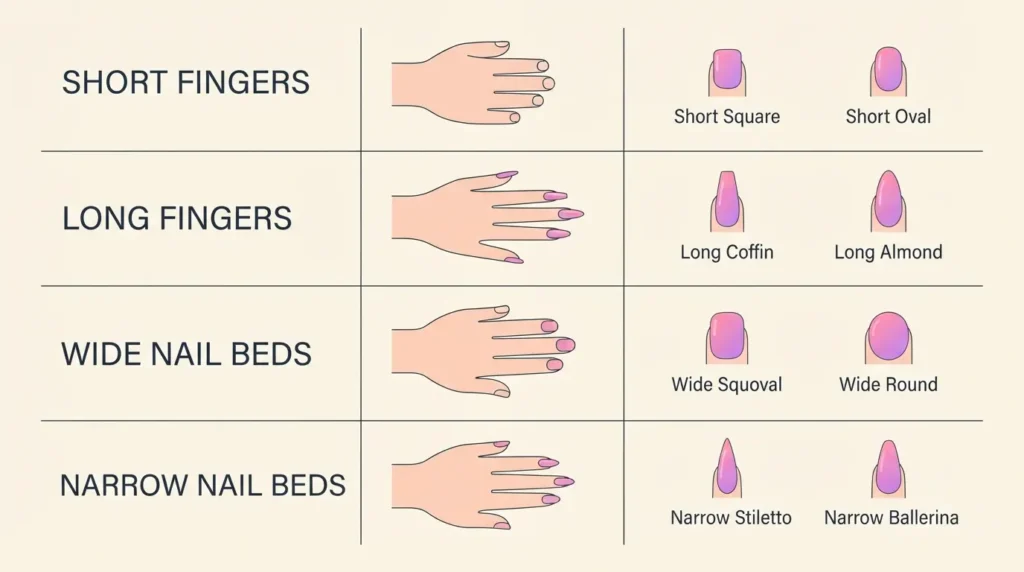
| Your hands | Best shape | Second choice | Avoid |
|---|---|---|---|
| Short fingers, wide nail beds | Oval | Almond | Square, coffin |
| Short fingers, narrow nail beds | Almond | Oval | Round |
| Long fingers, wide nail beds | Squoval | Oval | Round |
| Long fingers, narrow nail beds | Square | Almond | Round |
| Small hands, any bed | Oval | Round | Coffin, stiletto |
| Large hands, wide beds | Squoval | Square | Round |
| Very short nails, any hands | Round | Squoval | Everything else |
| Recovering nails, any hands | Squoval | Round | Almond, coffin, stiletto |
Two notes on this table. “Avoid” means the shape fights your proportions, not that it’s forbidden – wear whatever you want, you’ll just be working against the geometry. And nail strength overrides everything: a perfect anatomical match for stiletto on peeling nails is still the wrong answer.
The durability question nobody else asks
Here’s the part of the decision that gets skipped everywhere else.
A fingernail fails at its weakest cross-section under lateral force. Three things create that weakness:
- Corners. Stress concentrates at any abrupt change of angle. A square corner is a crack waiting for a reason.
- Taper. Removing sidewall material reduces the nail’s resistance to bending, and the sidewalls are what stop a nail folding sideways.
- Length. A longer free edge is a longer lever arm, so the same knock delivers more force to the stress point.
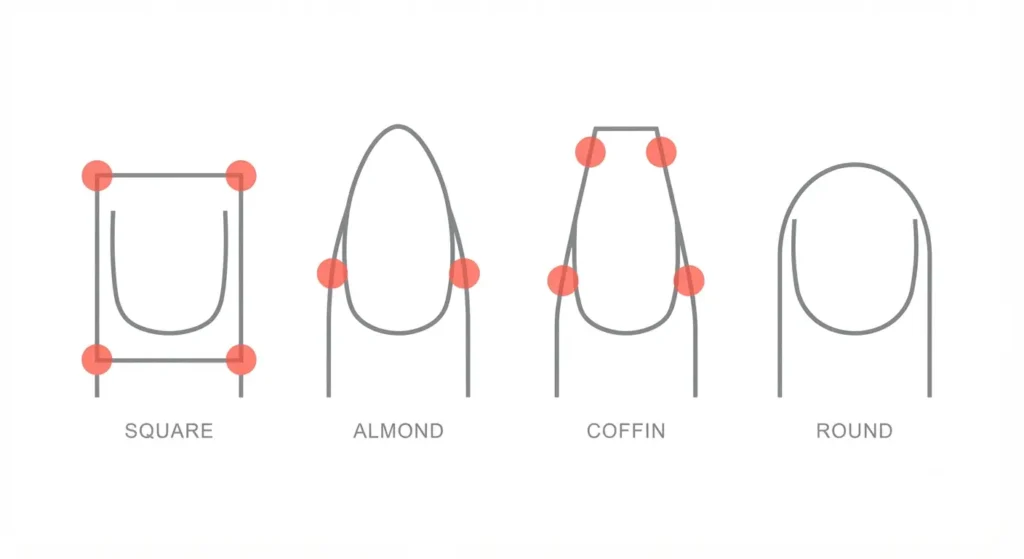
Square has corners but no taper. Almond has taper but no corners. Coffin has both. Round and squoval have neither, which is precisely why they’re the two most durable shapes.
Length is the variable you control most easily and think about least. Bending force at the stress point scales roughly with the square of free-edge length, so a 6 mm edge doesn’t take twice the abuse of a 3 mm edge – it takes closer to four times. This is why “same shape, just shorter” fixes so many breakage problems, and why the finder returns a length in millimeters instead of a vague “keep it short.”
Daily hand load is the other half. In the model, hands that lift weights, garden, or handle children daily count as high load; typing and general office work as moderate; light desk work as low. A shape that survives comfortably at low load can fail inside a week at high load, at identical length and nail thickness.
Step by step: getting the shape you actually want
- Run the finder and note both your match and your runner-up.
- Read the risk verdict. Green means go. Amber means go at the stated length. Red means shorten it, reinforce it, or wear the runner-up day to day.
- Copy the salon script. It contains the shape, the length in millimeters, and the finish instruction.
- Read the script out loud at your appointment. Technicians appreciate specificity far more than a Pinterest screenshot.
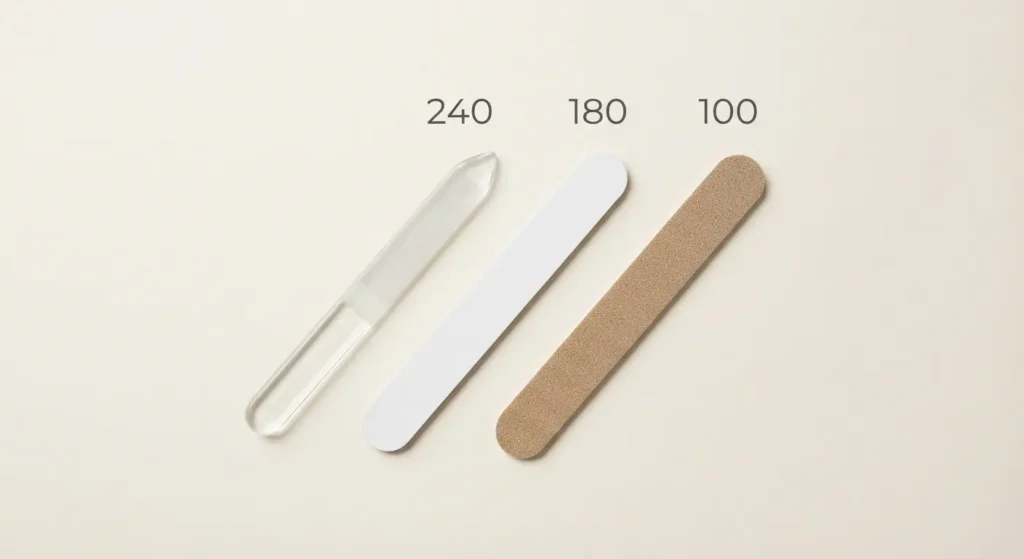
- At home, file in one direction with a 180-grit file. Sawing back and forth separates the nail layers and causes the peeling you’re trying to avoid.
- Seal the free edge every time you top coat – run the brush along the edge of the nail, not just across the surface. This one habit prevents a large share of splits.
- Re-run the finder in three months. Nail strength shifts with season, diet, and how long it’s been since your last set of enhancements.
Three real examples
The almond that kept breaking. Narrow nail beds, short fingers, thin nails after two years of gel, gym four times a week. Almond scores 91 on fit and 38 on survivability – 54 overall. The finder recommends squoval at 3 mm as the everyday shape, plus a 12-week grow-out plan to reach almond safely. She keeps the goal instead of being told no.
The square that looked wrong. Wide nail beds, average finger length, strong fast-growing nails, office job. She’d worn square for years because it lasted: fit 48, survivability 88. The finder recommends oval at fit 86, survivability 79 — the taper narrows the visual width of her beds. Durability was never the problem here; nobody had ever questioned the aesthetics.
The nurse. Balanced nail beds, long fingers, average strength, twelve-hour shifts with constant handwashing and glove changes. Almost every shape scores poorly on survivability because of hand load. Round wins at 2 mm, squoval second. The care plan leads with cuticle oil, because repeated sanitizer exposure is the real issue, not the shape.
Best practices
- File in one direction only, from the sidewall toward the center
- Use 180 grit or finer on natural nails – anything coarser tears the plate
- File dry, never straight after a shower, because softened nails file to an uneven edge
- Shape the sidewalls first, the tip last
- Check symmetry from below, looking up at your fingertips rather than down at them
- Seal the free edge with every top coat
- Oil your cuticles daily – plate flexibility improves noticeably within about two weeks
- Keep a file in your bag. Filing a small catch immediately prevents the tear that follows it
Common mistakes
- Choosing a shape from a photo. The hand in the photo has long, narrow nail beds. Yours probably don’t. The shape will not look the same on you.
- Sawing back and forth. The single most common cause of peeling and splitting. One direction, every time.
- Going too long, too fast. Length compounds risk faster than shape does. If you’re unsure, shorten first and change shape second.
- Ignoring nail strength. The most common failure in this whole category. A shape that suits your hands but not your nails is not a match.
- Filing after a shower. Soft nails file to a ragged edge that splits as they dry.
- Cutting cuticles. The cuticle is a seal. Push it back, don’t remove it.
- Switching shape every appointment. Each reshape removes material. Staying with one shape for three cycles lets the plate recover.
- Asking for a shape by name only. “Almond” means different things to different technicians. Length and peak sharpness need specifying -which is what the salon script does for you.
Expert tips
- The runner-up is the right answer more often than you’d think. If your top shape carries an amber or red verdict, live in the runner-up and save the top pick for events.
- Match the peak to the center line. On almond, if the peak sits even 1 mm off center, the whole hand reads asymmetrical.
- Short almond beats long oval for elongation on short fingers. The taper does more work than the length does.
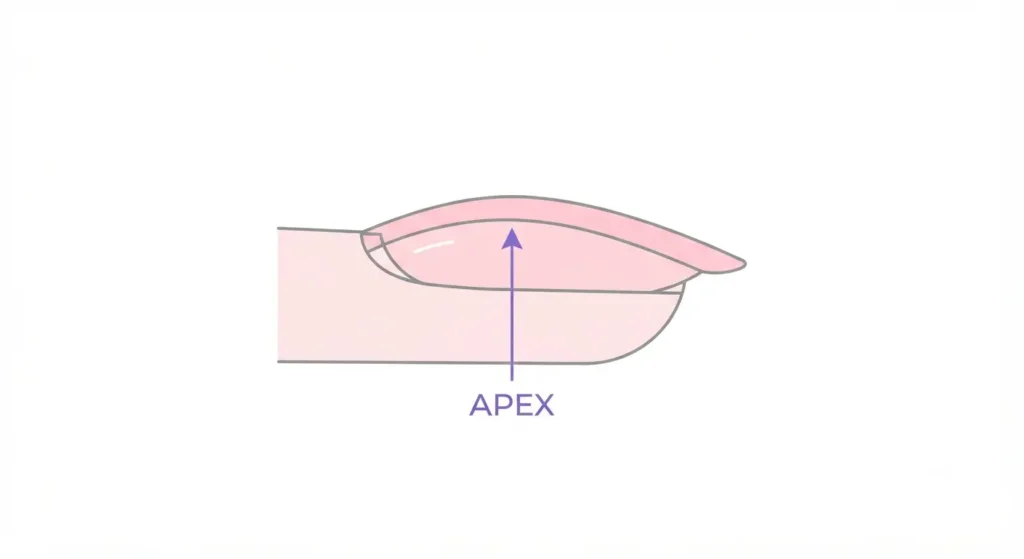
- Build an apex if you wear gel. A slight thickness peak about a third of the way up the nail prevents more breakage than shape choice does.
- Seasonal brittleness is real. Nails are more fragile in winter. Consider dropping one step in durability from November through February.
- Rotate annually. Squoval in winter, almond in summer, round through any recovery period.
Advanced use cases
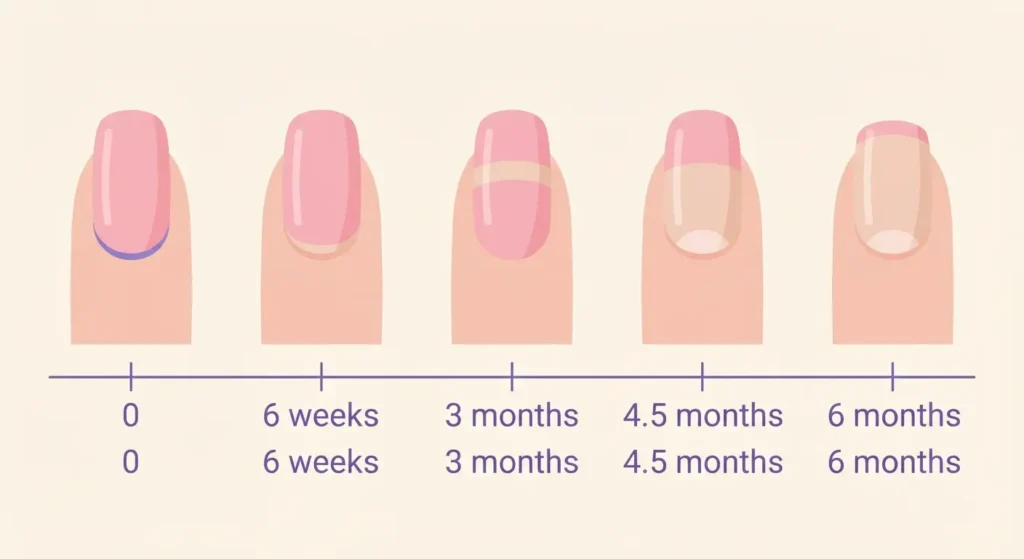
Growing nails back from damage. Round or squoval at 1–2 mm, daily cuticle oil, minimum eight weeks. Don’t attempt a taper until you’ve grown a full new plate, which takes roughly four to six months from cuticle to free edge.
Preparing for an event. Work backwards. Two weeks out, switch to your target shape at a safe length. One week out, do the final shape. Never debut a new shape on the day.
Nail technicians running consultations. Use the finder on a tablet during intake. The result screen gives you shared vocabulary with the client and, more usefully, a neutral third party to point at when a request won’t survive their lifestyle.
Press-on sizing. Aspect ratio matters more than width alone. A wide short bed and a wide long bed take different sizes despite an identical width measurement.
What’s actually trending right now
Shape trends move on roughly a three-year cycle. Coffin and stiletto peaked with the extension boom, and the market has since moved toward shorter, more natural shapes – short almond and squoval currently dominate salon requests.
That shift is partly aesthetic and partly practical. As more people wore extensions long term, nail plate damage became widespread, and shorter shapes are the recovery position. The measurable consequence is that durability now sells: for most people, a shape that lasts three weeks is worth more than one that photographs better.
Privacy
The nail shape finder runs entirely in your browser. Your answers and measurements are processed on your device and never transmitted to our servers, because there is no server component to this tool. We don’t require an account, collect an email address, or store your results anywhere except your own browser’s local storage, which you can clear whenever you like.
If you use the shareable link feature, your answers are encoded into the URL itself — anyone you send that link to can see them, so treat it like any other personal message.
Accuracy
This tool gives a reasoned recommendation, not a professional diagnosis. It’s built on established principles of hand proportion and nail structure and was reviewed by a licensed nail technician, but it can’t see your hands. The result is a strong starting point that will be right for most people most of the time. A skilled technician looking at your actual nails will always have more information than a five-question form.
Limitations
- The tool assumes typical nail anatomy. It does not account for medical nail conditions such as psoriasis, onychomycosis, clubbing, or spooning. If you have a diagnosed nail condition, speak to a dermatologist before changing your shape or length.
- The breakage forecast is a statistical estimate, not a prediction about your specific nails.
- It covers seven mainstream shapes and does not include lipstick, arrowhead, edge, or flare.
- Hand-entered measurements carry your own margin of error — expect around ±1 mm.
- Recommendations assume natural nails or a standard gel overlay. Sculpted acrylic extensions follow different structural rules.